


















ISRO detects possible subsurface ice near Moon’s south pole using Chandrayaan-2 data
text_fields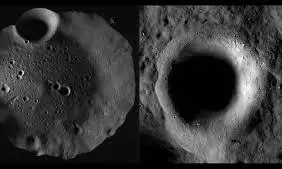

The Indian Space Research Organisation has identified strong signs of possible subsurface water-ice deposits beneath permanently shadowed craters near the Moon’s south pole using radar data from the Chandrayaan-2 orbiter.
Researchers found promising signatures inside a 1.1-kilometre region within the Faustini crater, one of four craters studied in the area.
According to ISRO, the Faustini crater showed the strongest indications of underground ice based on radar observations and its distinctive “lobate rim” structure. Scientists said this curved, flow-like rim shape may form when an impact strikes ice beneath the surface, causing material to move and reshape the crater edges.
The region remains in permanent darkness and never receives sunlight, keeping temperatures extremely low at around 25 Kelvin, or nearly minus 248 degrees Celsius. Scientists believe such conditions are ideal for preserving water ice for long periods.
The findings are based on data collected by Chandrayaan-2’s Dual Frequency Synthetic Aperture Radar, or DFSAR, which uses microwaves to study the lunar surface in L-band and S-band frequencies.
The study focused on “doubly shadowed craters”, which are craters located inside permanently shadowed regions near the lunar south pole.
Scientists developed a method to identify possible underground ice using radar signal patterns. According to the study, a Circular Polarization Ratio higher than 1, along with a Degree of Polarization lower than 0.13, may indicate subsurface ice deposits.
Researchers said lower Degree of Polarization values could suggest radar signals scattering within ice or ice-like material rather than from rough rocky surfaces.
The method helps scientists distinguish between radar signals caused by underground ice and those produced by uneven terrain.