















What is Christmas? beliefs, traditions and modern practice
text_fields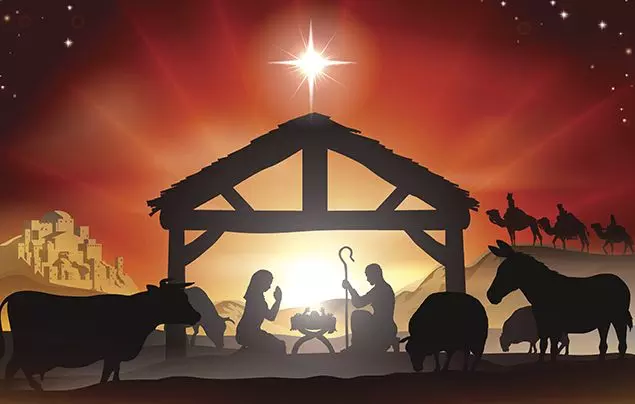

The most widely celebrated Christian festival is Christmas. It is marked by many who belong to other faiths or to no faith at all. There are some Muslims who celebrate it on the grounds that Jesus is a prophet of Islam.
People occasionally write Christmas in the short form ‘Xmas.’ Note that the T in Christmas is silent. It is pronounced ‘KRISS muss’’
Christmas is celebrated on 25 December in Western Christianity. Eastern Christianity celebrates it on 7 January. Western Christianity means Catholic and Protestant Christians who are most Christians in the American Continent, Africa, Western Europe and Asia. Eastern Christianity means the Orthodox Church, which is the main Christian denomination only in Russia, Greece, Serbia, Ukraine and Belarus.
The word Christmas is derived from Christ (‘saviour’ in Ancient Greek) and mass (a Christian religious ceremony). Christians believe that Jesus is the son of God as well as being God himself. This is called the Holy Trinity: there is God the Father, God the Son (i.e. Jesus Christ) and the Holy Spirit.
But there is ONE God and not three. This raises some difficult questions. How can God be his own father? How come there is a Trinity if there is only one God? Christians say it is like water has three states of water: liquid, gas and solid, but all are water. As Jesus Christ was born of a woman (the Virgin Mary), how is he God and not a human being? Christians believe that Jesus Christ is fully God and fully human. This seems to be a conundrum, as surely these two are mutually exclusive.
Christians say that the finite cannot contemplate the infinite. That is to say that humans are so mentally limited that they cannot possibly understand God. Although Christians refer to God by masculine pronouns, Christians believe that God is sexless.
Christmas is about the Nativity (i.e. the birth) of Jesus. Most of the story is taken from the Gospel according to St Luke, which is one of the books in the Bible. A ‘book’ in the Bible is the equivalent of s surah of the Holy Koran. A gospel is a biography of Jesus found in the Bible. Gospel means ‘God narrative’ in Anglo-Saxon.
The gospels are thought to be the most crucial books in the Bible for Christians and those who are inerrant. That is why Christians say something is ‘Gospel truth’ to mean absolutely trustworthy and veracious. The four Gospels are by saints Matthew, Mark, Luke and John, which is why those are such popular boys’ names.
The Virgin Mary was engaged to a carpenter named Joseph, who came from Nazareth. An Archangel appeared to the Blessed Virgin Mary and announced to her that she would become pregnant despite being a virgin. This would be a miracle effected by the Holy Spirit. This is called the Immaculate Conception: i.e. she conceived a child without engaging in intercourse. Joseph then married Mary, and she was already pregnant with Jesus.
It was crucial to emphasise that the Blessed Virgin Mary became gravid by the power of the Holy Spirit and not by any physical act. In the mythology of Ancient Greece and Ancient Rome, the gods had bodies and could copulate with women and sire demigods. The Bible wished to exclude this possibility.
The Feast of the Annunciation is marked by some Christians on 25 March, i.e. 9 months before Christmas Day. This is why Mother’s Day is the nearest Sunday to 25 March.
The Bible says that the Roman Emperor ordered a survey of his colonies. There is no record of this in the Roman archives. People were ordered to return to the hometown of their ancestors to make the survey more logical. Joseph took his goodwife to Bethlehem, his ancestral home.
His wife was in labour, but there was no room at the inn. The innkeeper allowed the couple to stay in a stable. There, the Virgin Mary gave birth with the oxen and donkeys looking on. The infant Jesus was laid to sleep in a manger full of hay. This is supposed to signify his humility despite his divine status.
Angels then descended to the Earth and informed the shepherds that Jesus had been born, and the child was resting in a nearby stable. Again, the fact that lowly shepherds were the first to be told is intended to demonstrate that Jesus came for those of low socio-economic status. The shepherds hastened to the stable to greet the infant and offer their good wishes.
In Bethlehem, you can see the room in which Jesus was supposedly born. How does anyone know that it was this room? How can a jerry-built stable survive 2000 years? It was probably rebuilt much later.
Jesus being born in Bethlehem is important because there was a prophecy earlier in the Bible that stated that the Messiah (Hebrew for ‘anointed one’) would be born there. Moreover, he would be a descendant of King David. King David was an ascendant of the Virgin Mary.
The Magi or Wise Men were informed that a king had been born. Magi are priests of Zoroastrianism. The Gospel of St Luke claims that the Magi followed a star by night, which led them to the stable where Jesus lay. The names of Magi are Balthazar, Caspar and Melchior. They brought him gifts: gold, frankincense and myrrh. They are often erroneously called the ‘three kings’. They are often depicted as one black, one white and one Oriental to suggest that Jesus came for all races.
The Magi following a star may refer to a comet that appeared in the Year 4 BC. The year Jesus was born is unclear. Christian years are AD (Anno Domini, which is Latin for ‘Year of the Lord’). Thereafter, AD years count down after the birth of Jesus Christ. Some prefer to use a secular name for this system of years and call it CE (Current Era) and, rather than BC (Before Christ), call those years BCE (Before Current Era).
The visit of the Magi (or Wise Men) to baby Jesus is called the Feast of Epiphany. In Western Christianity, this is marked on 6 January. 6 January is 12 nights after Christmas Day. It is meant to mark the end of Christmas. People traditionally removed their Christian decorations that night.
The Holy Bible says that King Herod of Judea (i.e. Palestine) found out that a king had been born. The Magi had called on him first on their way to Bethlehem and asked if he knew where the boy king had been born. Herod said he did not know but asked the Magi to tell him where the child was once they found him.
This the Magi agreed to do. Later, angels warned the Magi not to go back to Herod because if Herod found out where Jesus was, then Herod would surely slay the child. Herod was an evil ruler and feared he would be overthrown. King Herod did not know who this child was or where exactly the child had been born. So, Herod then decided to slay all newborn boys lest the boy grow up and one day overthrow him.
The Holy Family (Jesus, Mary and Joseph) were informed that Herod intended to kill the child. Therefore, they fled to Egypt. Thousands of baby boys were murdered by Herod and are known as the Holy Innocents. After several years, it was safe to return to Judea (Palestine), and the Holy Family went to live in the town of Nazareth.
There is no reason to believe that Jesus was born on 25 December. The Bible gives no indication of what date he was born.
How is Christmas celebrated today? 1 December marks the beginning of Advent (‘towards the coming’ in Latin). People put up Advent calendars on the wall, and these display Christmas images. There are windows on the calendar to open – one window each day up to 25 December. Open the window, and there is a chocolate to eat. Some children open all the windows on the first day to eat the chocolate immediately. People often start putting up decorations in November. Shops start advertising Christmas presents. People wear clothes with Christmas scenes.
Christianity decided to mark Christmas on 25 December. There is a theory that it was to replace Saturnalia, a Roman pagan festival that was celebrated about the same time.
Winter is dark and cold in Europe, and people need a festival to break up the winter. There is thus something to look forward to as the weather gets worse. Per force people spend a lot of time indoors. In the summer, people in Europe do not need a festival because it is warm and pleasant to be outside, and the sun stays up till 11 pm in some places. Christianity started in Palestine but spread to Europe and that became the focus of the religion for many centuries.
In Scandinavia, they called it Christian Yule (spelt Juul in Norwegian). Because deciduous trees shed their leaves in autumn, the Scandinavians tried to cheer themselves up by felling a coniferous tree and bringing it into the house. Coniferous trees do not shed their pine needles, as the wax on the pine needles ensures that water cannot settle on them and freeze them. The greenery of the coniferous tree reminds people that summer will come again and there will be verdure everywhere. Note that Christmas trees are not a Christian symbol and were used in Scandinavia when it was pagan.
The traditional Yule log or Christmas tree spread to Germany. Queen Victoria wed her first cousin, Prince Albert, in 1840. Prince Albert came from Germany and brought the Christmas Tree custom with him to the United Kingdom. From the UK, this spread like wildfire all around the British Empire and then around the world.
Queen Victoria sent Christmas cards to people. This became a very popular practice. In the weeks before 25 December, people send these cards bought in shops, and the cards display Christmas images. The images can be explicitly religious or sometimes nonreligious. There could be an image of the Infant Jesus and the Virgin Mary; the Three Wise Men adoring the baby Jesus, or the angels announcing the birth of Jesus to the shepherds. Nonreligious images include a Christmas Tree or a Snowman.
A Christmas card may have an openly religious message, usually ‘Merry Christmas’. Some people are aware that not everyone is a Christian and use a neutral salutation, ‘Season's greetings.’ The sender will usually write a few sentences as well. A Christmas card might be from one family to another, with all the members of the sender’s family signing it, and the card mentioning all the members of the recipient family.
In many schools, the children put on a Nativity play – i.e. a theatre piece that tells the story of the birth of Jesus, complete with the visit of the Magi. Christianity has long considered it entirely permissible for actresses to play the role of the Virgin Mary. This is not blasphemous, but simply making the religion more understandable. A doll is used to represent the Infant Jesus.
In many houses, the family will have a crib: a Nativity scene made to look like a stable with figurines to represent the biblical characters. The manager is left empty until Christmas Day. Only on 25 December is the figure of Jesus placed therein.
In the Dark Ages in Anatolia (i.e. Türkiye), a poor family resided, and the parents could not afford dowries for their three daughters. A kind man named Nicholas lived nearby. He decided to give the girls dowries, but being modest did not want gratitude or praise. Therefore, he must give them dowries anonymously. He entered the house in the middle of the night by the chimney and left three gold balls. Somehow it came to be known that Nicholas was the altruist who donated the gold balls. When he died, he was canonised (made a saint). St. Nicholas is sometimes known as Santa Claus or Father Christmas.
In the Netherlands, he is Sint Nikolaus. He arrives on 6 December on a horse, having some from Spain and accompanied by his servant Zwarzes Piet (Black Peter). Zwarzes Piet is a white man in blackface. Some think this is racist.
In Russia, the equivalent of Santa Claus is ‘Ded Moroz’, meaning ‘Old Man Frost’. He goes around with his granddaughter Snegorochka (‘Little Snowy’).
All versions of Santa Claus or Father Christmas agree on him being an old man with a white beard. He is often shown as being chubby and rubicund.
Traditionally, Santa Claus was depicted wearing green. A Coca-Cola advertisement in the 1930s showed him in red, which is the colour of Coca-Cola. Thereafter, people usually showed Santa as wearing a red suit with white trimmings and black boots.
Children are told that Santa Claus lives at the North Pole. He and his elves work making toys every year. He flies around on a magic sleigh pulled by reindeer. Some children are told to write letters to Santa Claus requesting presents. Parents tell the kids that if they are well-behaved, they will receive many presents, but if they are bad, then they will receive little or nothing. I know of one family where a boy was badly behaved after Christmas, and Santa Claus came back in the middle of the night and took his presents away!
There is a famous 20th-century song Rudolf the Red-Nosed Reindeer. This is one of many pop songs about Christmas.
Some people leave snacks and drinks out for Santa and his reindeer. In the morning, these will be seen to have been partly eaten. Of course, it is the parents who do this to make Santa seem real.
It is difficult for children when they come to realise that Santa does not exist. The myth is maintained by parents to make Christmas more fun.
In Germany, the Christmas custom is that a mysterious creature leaves children Christmas presents. But he is accompanied by Krampus with a sack and a stick. Good children are rewarded with gifts, but wicked ones are tied up in the sack and beaten soundly.
In Germany, Christmas is mainly celebrated on Christmas Eve, 24 December. The British royal family follow suit due to their Germanic heritage.
In the UK, the King’s Speech is broadcast on TV in the afternoon. It is about 2 pm and lasts around 10 minutes. It dates back to George V in the 1930s on BBC Radio.
Some Christians go to midnight mass: a church service beginning about 11 pm on 24 December and going on till just past midnight. This involves Christmas carols – religious songs especially about Christmas. Many people who attend this service go at no other time of year. Some people go to church that day solely for the music and not out of any religious devotion.
A Carol Service is the name of a specific religious ceremony involving Nine Lessons (i.e. readings from the Bible) and Nine Carols. The first Carol Service as we know it took place at Trinity College, Cambridge in 1918. It has been copied all around the world. It is broadcast live. A choir boy sings the opening hymn as a solo. Three boys are trained for months to do this. The one who is actually going to sing is informed only seconds before broadcast. That is so he will not have time to get nervous.
Some people attend church on Christmas Day rather than Christmas Eve. Some people go to church on both days. There are plenty of nonreligious people in Western countries who do not attend church at all.
Some people swim in the sea or a lake on Christmas Day despite it being cold.
Almost all businesses are shut on this day, and there is no public transport. Emergency services are open. It is a day when almost everyone is off work, so it is a chance to visit people whom one does not usually have time to visit.
Christmas dinner is eaten on 25 December. There is no religious significance to what people eat or drink. People often entertain each other with party games such as charades.
In the US and many Western countries, the main dish is turkey. Before turkeys were brought from America to Europe, it was the goose that was customary. In some European countries, people usually eat pork or fish.
A British Christmas dinner consists of turkey, roast potatoes, Brussels sprouts and gravy. There is stuffing inside the turkey. People often have ham too.
At Christmas dinner, people have Christmas crackers at their place. People pull the crackers together, and it makes a bang sound, and a paper crown is removed, as well as a joke written on paper.
People sometimes eat Christmas pudding, which is a fruitcake. It is often doused in brandy, and the brandy is lit – giving off a blue flame.
The diners can seldom finish Christmas dinner because there is so much food. They end up keeping the turkey in the fridge and re-heating it and eating it over a few days.
All this food, music, and merriment helps people counteract Seasonal Affective Disorder (SAD) in cooler climes. However, people tend to put
People will give Christmas presents to all the members of their immediate family and perhaps some of the extended family. Sometimes people give presents to friends, too.
Christmas is meant to be the season of goodwill. People greet perfect strangers with ‘Merry Christmas’. But many miss the message of generosity and abnegation. Some are only materialistic.
Much of our notion of Christmas comes from a novella by Charles Dickens, A Christmas Carol.’ In this story, there is a mean-spirited and miserly character named Scrooge. Scrooge has come to be a word for any tightfisted or curmudgeonly person. It mentions snow at Christmas a lot. This is because the 1820s, when Dickens was a child, were very snowy due to a mini-ice age. In fact, in the UK, it snows more in January than in December.
The shops will stock up for Christmas. Items they did not manage to sell by 25 December go on sale afterwards. The January Sales begin on 26 December. There are often big price drops. The crass commercialism is something that some people consider to be unpalatable.
26 December is known as Boxing Day in the UK. This is unrelated to the sport of boxing. It is because Queen Victoria gave a box of presents to her servants on this day. It is also a public holiday.
There are some fox hunts and horse races on Boxing Day.
Christmas is a bad time to travel. The roads and railways, and airports are full. Snow and ice often lead to delays and cancellations. It is twice the price to buy an air ticket compared to a less busy time of year.