













Reversal of roles? British Air Force pilot to be trained by Indian Air Force
text_fields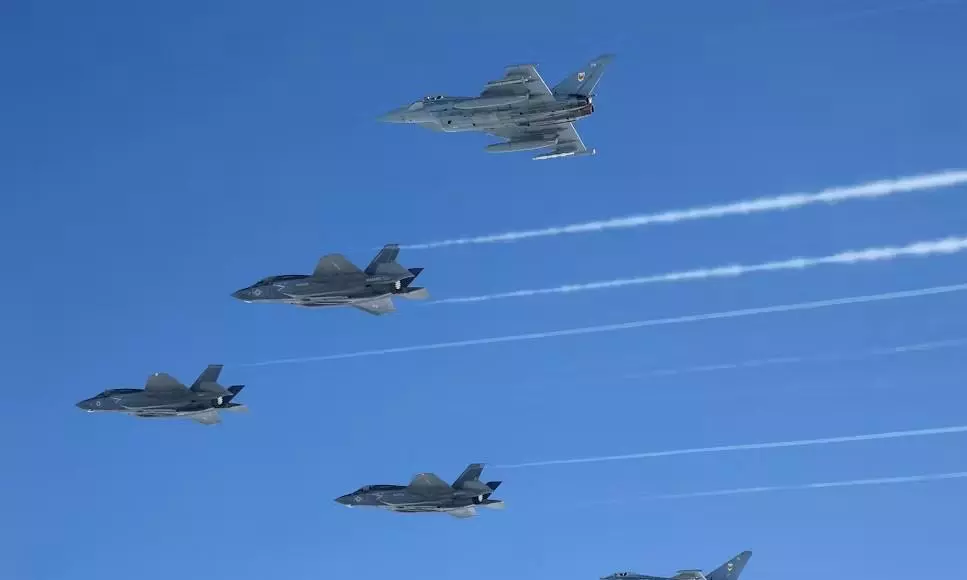

On October 16, it was announced that for the first time ever, the United Kingdom’s Royal Air Force (RAF) will have new pilots trained by instructors from the Indian Air Force (IAF).
As of October 2026, the RAF will have IAF instructors working with British cadets who train in Hawk T2 fast jets. The United Kingdom is taking this unprecedented step for two reasons: a shortage of manpower and also deepening ties with India.
The RAF has had foreign instructors for a few years. The RAF has recently praised the IAF’s expertise. The IAF was founded by the RAF in the 1920s. The rank structure and insignia are nearly identical. Therefore, for IAF officers on secondment to the RAF, it will be a very smooth transition. Notwithstanding the Modi Administration’s endeavour to promote the use of Hindi, the IAF uses English as its language of command.
The agreement will lead to at least IAF officers being posted to an air base called RAF Valley. They will be trained on RAF aircraft. These IAF officers are already instructors in their own air force. However, India does not operate most of the planes that the RAF has. Once they are conversant in British warplanes, they will train RAF cadets at Number 4 Flying Training School.
The salaries of the IAF personnel will still be paid by India. However, accommodation will be provided by the United Kingdom. Why has India agreed to this when it is not gaining financially? It is seen as part of a general thawing of relations between the two Commonwealth countries.
The Labour Party was ushered into office in the UK in 2024. Traditionally, Labour has more cordial relations with India than the Conservative Party. It was a Labour Government that agreed to Indian Independence when some Conservatives were minded to refuse. The Indian community mostly votes Labour. In the 1980s, 90% of British Indians voted Labour. It is now 60%. That is partly because of the embourgeoisement of the community.
The Prime Minister of the UK, Sir Keir Starmer, recently visited Mumbai, where he met Prime Minister Modi. They inked a trade agreement. India had hoped for visa liberalisation, but Starmer said a firm no. The UK Government is under severe pressure over perceived excess immigration.
His Majesty’s Government has tried to spin this training agreement as a win for the United Kingdom. It demonstrates that the UK and India have a more collaborative relationship than heretofore. In recent decades, India had been perceived to be at best cool towards Western countries and particularly towards the former colonial metropole.
India is a lynchpin of the BRICS (which was originally Brazil, Russia, India, China and South Africa). This training agreement is supposed to prove that London has succeeded in winning India around to be more sympathetic to the British viewpoint.
The flipside of the training agreement is that it will amount to humiliation for the UK that it needs it. The British Armed Forces suffer severe problems with recruitment and retention. Not enough people volunteer. Too many opt to leave after 5 years rather than making a full career of it.
The armed forces are haemorrhaging very expensive trained cadres. His Majesty’s Armed Forces do not offer an attractive lifestyle. The accommodation is substandard and often suffers from mould. The UK has also bred a generation of wimps. Education in the United Kingdom is not merely broadminded and self-critical of Britain’s past: it is actively anti-patriotic.
India may hope to gain access to some British military technology. The United Kingdom is selling GBP 350 million worth of missiles to the Indian Army.
In October 2025, the Royal Navy carried out joint exercises with the Indian Navy. The aircraft carrier HMS Prince of Wales took part. Note Royal Navy ships always have the prefix HMS (‘His Majesty’s Ship’).
The UK has been frank about its efforts to woo India. It lauds India’s democracy. It compares very favourably to India’s neighbours. Britain’s economic growth is sluggish, and increasing trade with India is an obvious solution.
Despite the British charm offensive against India, there are some in India who are not keen on building a cooperative relationship with the UK. Indians are increasingly outspoken in their belief that the United Kingdom oppressed and exploited India. Many demand reparations. Oddly, in the first few decades, very few people in India said this even though they were the ones who had lived under the British Raj. Under 1% of the population of India today was alive in 1947. As the British epoch is no longer in living memory, people are ever more forthright in castigating Britain’s record in South Asia.
There are those in the British defence establishment who do not entirely trust Indians. They are cognizant that India is neutral on the Ukraine War. There are plenty of Indians who can be found to speak up for the Kremlin’s position on Ukraine. Indeed, a few Britons feel the same way. Some British defence figures fear that giving Indians access to RAF bases will mean that an Indian might, either from ideological conviction or for filthy lucre, give intelligence to Russia or other hostile states such as Iran.
India is also more favourably disposed towards the United Kingdom than it was a few years ago. This is partly because relations with China are bad. Moreover, the UK has stopped placating Pakistan. When British troops were in Afghanistan, the United Kingdom was loath to irk Pakistan for fear it would make Pakistan even more helpful to the Taliban. The British Armed Forces withdrew from Afghanistan in 2021. There is now no particular reason for the UK to desist from developing close ties with India. India has raced ahead of Pakistan economically. The British are eager to increase commerce with India. Pakistan has nothing to offer.
There are other factors behind the recent rapprochement between London and New Delhi, such as India, at the moment, has fairly poor relations with the USA and Canada. Therefore, it makes sense to improve ties with another major Western nation.
Note that in the UK, the air force is never called the ‘British Air Force’ but always the ‘Royal Air Force’ (RAF). There are many other countries with monarchies and the word ‘royal’ in the title of the air force, but only the UK does not bother to state the nationality. That is partly because the RAF is one of the oldest in the world, founded in 1918. There was military aviation for a few years before that, but prior to 1918, it was part of the army.