
















The Lancet study finds discrepancies, says Gaza death toll was substantial undercount
text_fields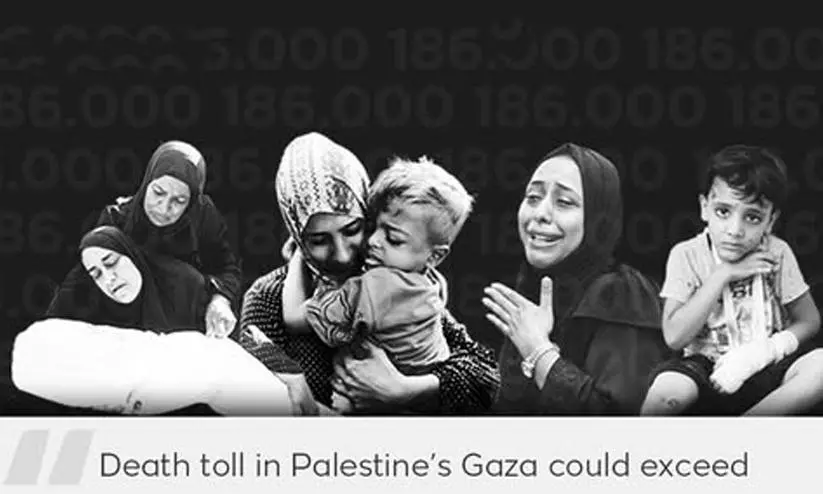

A new peer-reviewed study has found stark discrepancies in the reported death toll in Gaza since Israel began its devastative assault in October 2023, and although the cumulative figures have long variegated in accordance with counts released by the Gazan health authorities, figures that a senior Israeli security official recently acknowledged were broadly accurate, the fresh research suggests that the official tally was nonetheless a substantial undercount.
The study, published in the medical journal The Lancet Global Health, estimates that more than 75,000 people were killed violently in the first 16 months of the war, a figure at least 25,000 higher than what local authorities had announced for that period.
Drawing on a carefully stratified survey of 2,000 households across the Gaza Strip, researchers sought to reconstruct mortality patterns through direct testimony, thereby circumventing the distortions that often accompany wartime reporting.
The findings indicate that between 7 October 2023 — when Hamas launched its surprise incursion into Israel, killing around 1,200 people and abducting approximately 250 — and 5 January 2025, a total of 42,200 women, children and elderly people were killed. These deaths comprised 56 per cent of all violent fatalities, thereby challenging Israeli assertions that combatants and non-combatants were killed in roughly equal measure.
The authors, an interdisciplinary cohort including an economist, a demographer and epidemiological specialists, further estimated that around 8,200 additional deaths during the same period were attributable to indirect causes such as untreated disease and malnutrition, although they rejected more expansive projections advanced in earlier analyses.
The paper contends that, as of early January 2025, between 3 and 4 per cent of Gaza’s population had died violently, a proportion that underscores both the ferocity and demographic concentration of the conflict.
The precise death toll has remained bitterly contested, yet last month a senior Israeli security officer informed journalists that the figures compiled by Gaza’s health authorities were broadly reliable, marking a conspicuous reversal after years of official scepticism.
The officer reportedly estimated that approximately 70,000 Palestinians had been killed by Israeli attacks since October 2023, excluding those listed as missing, while Gazan officials now place the direct toll above 71,660, including more than 570 deaths recorded after a ceasefire took effect in October 2025.
The study covers what researchers describe as the most intense and lethal phase of Israel’s offensive, though it does not encompass the zenith of the humanitarian catastrophe, as famine was declared in Gaza in August 2024 by UN-backed experts. A separate inquiry by the Max Planck Institute for Demographic Research similarly estimated over 78,000 deaths during a comparable timeframe and documented a precipitous collapse in life expectancy.
Researchers caution that definitive accounting will demand years of forensic and demographic reconstruction, and they acknowledge significant margins of error; yet the study stands as one of the most rigorous attempts thus far to quantify the human cost of a war whose devastation has altered Gaza’s demographic architecture in ways that may reverberate for generations.