









Iran's insistence on a halt to Israeli strikes, Trump's warning render talks fragile
text_fields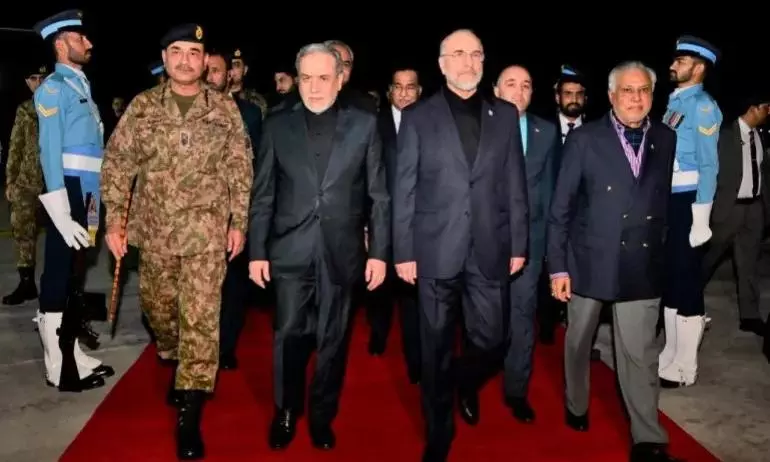
The Iranian delegation led by parliament speaker Mohammad Bager Ghalibaf and Foreign Minister Abbas Araghchi, centre, is welcomed by Pakistan’s Chief of Army Staff Asim Munir and Minister for Foreign Affairs Mohammad Ishaq Dar in Islamabad

The stakeholders of a ceasefire talk reportedly reached Islamabad, though the Iranian delegation’s arrival was uncertain owing to Israel’s continued bombardment of Lebanon even after a ceasefire had been included in the preconditions set by the US and Iran for a temporary truce.
The US President once again opened his foul mouth over the lives of Iranians with a comment that lives were left in Iran only because of the proposed negotiation, with a warning that sophisticated weapons were being loaded to pound Iran in the event of failure of the talks.
The fraught diplomatic build-up gathered pace as US Vice-President JD Vance departed for Pakistan, projecting guarded optimism while simultaneously cautioning Tehran against attempting to “play” the US.
Iran, however, insisted that it would not participate in substantive negotiations until Israel halted its bombardment of Lebanon, a condition that exposed deep fissures in interpretations of the two-week ceasefire reportedly brokered earlier this month.
Iran’s parliamentary speaker, Mohammad Bagher Ghalibaf, who was expected to co-lead the delegation, reiterated that two mutually agreed measures, a cessation of hostilities in Lebanon and the release of Iran’s blocked assets, remained unfulfilled, and he insisted that negotiations could not commence until these prerequisites were honoured.
Reports suggested that Israel had earlier removed Ghalibaf and Foreign Minister Abbas Araghchi from its target list at Washington’s request.
Iranian officials, alongside Pakistani mediators facilitating the fragile diplomatic engagement, maintained that the two-week ceasefire arrangement concluded between the US and Iran on the night of 7 April explicitly encompassed Lebanon. However, this interpretation was forcefully repudiated by Donald Trump and Israel’s Prime Minister, Benjamin Netanyahu, who contended that the understanding contained no such provision.
Lebanon and Israel agreed to meet in Washington DC on Tuesday to discuss a ceasefire and set a date for talks, with the meeting scheduled during a call involving ambassadors Nada Hamadeh Mouawad, Yehiel Leiter and Michael Issa, to be mediated by the US State Department.
Meanwhile, Donald Trump amplified tensions through bellicose rhetoric, declaring that US forces were rearming with “the best ammunition” and would deploy it “very effectively” should negotiations fail, before further asserting that Iran possessed “no cards” and survived only to negotiate.
The continued Israeli strikes in Lebanon, which have reportedly killed more than 300 civilians since the ceasefire began, deepened mistrust, with Lebanese authorities confirming casualties among state security personnel following an attack on a government facility in Nabatieh.
The Islamabad negotiations are expected to address the reopening of the Strait of Hormuz, the future of Iran’s nuclear programme, sanctions relief, and demands for reparations, while the US is also likely to press for the release of detained Americans.
Advance teams from both sides reportedly occupied rooms at Islamabad’s Serena Hotel under an extensive security lockdown, with Gulf representatives arriving to safeguard regional interests and Pakistani officials shuttling messages between delegations.
Even as diplomacy unfolded, hostilities persisted across southern Lebanon, with Hezbollah launching rocket barrages and Israel conducting airstrikes.