











Unease building in Kerala CPI(M) against Pinarayi Vijayan
text_fields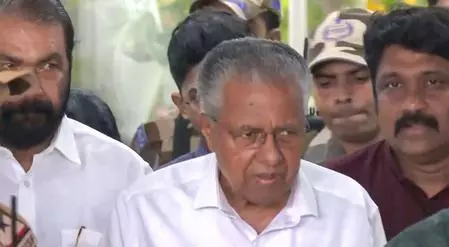
Photo: IANS

Thiruvananthapuram: Pinarayi Vijayan has been the most dominant figure in the Kerala CPI(M) for nearly three decades, first as state secretary and then as Chief Minister, and he continues to be the party's center of gravity despite the Left's crushing electoral defeat.
But the unprecedented concentration of authority around one leader appears to be facing its first serious test from within.
Vijayan’s long run began in 1998, when he took over as CPI(M) state secretary, IANS reported.
Over the years that followed, his influence over the organisation steadily expanded, eventually making him the most dominant political figure.
By the time the 2016 Assembly election arrived, the organisational balance of power had shifted decisively in his favour.
The 2016 election, however, was fought under the leadership of V.S. Achuthanandan, whose campaign and popularity played a significant role in bringing the Left Democratic Front back to power.
Vijayan subsequently emerged as Chief Minister, beginning an unprecedented decade at the helm of the Kerala government.
He went on to become the first leader in Kerala to serve two consecutive full terms as Chief Minister.
During this period, his authority extended well beyond the government to the party organisation, making him, in practical terms, the final arbiter of most major political questions.
The 2026 Assembly election has now altered that equation.
The scale of the Left’s defeat, including the loss of several traditional CPI(M) strongholds, has raised questions that can no longer be confined to individual constituencies or the performance of local cadres.
Yet, even after the electoral debacle, Vijayan continues to exercise enormous influence over the party’s political narrative.
His explanations for defeats in Kannur have only sharpened the debate, with sections of the organisation questioning whether responsibility is being pushed downwards instead of being examined at the leadership level.
What makes the present moment particularly significant is not an open rebellion -- there has been none so far -- but the emergence of a sense of unease within sections of the party.
Leaders who have remained largely silent during Vijayan’s long tenure now find themselves confronting a difficult question: can the party seriously undertake a process of introspection without examining the role of its most powerful leader?
That makes the extended CPI(M) state committee meeting scheduled in Kozhikode later this month the most closely watched organisational gathering in the party since the election.
The meeting will not merely be about Taliparamba, Payyannur or the loss of traditional strongholds.
It could become a larger reckoning over the style of leadership that has prevailed in the Kerala CPI(M) for almost three decades.
The question hanging over the September 13-15 Kozhikode meeting is therefore larger than the electoral defeat itself. After years of exercising a near-unquestioned authority, will Pinarayi Vijayan continue to hold the party with the same iron grip or has the 2026 verdict finally opened the door to an internal assertion against the Pinarayi era?