



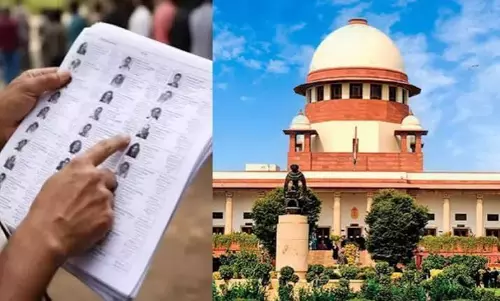














Supreme Court warns against replacing punishment with compensation
text_fields

The Supreme Court has set aside a Madras High Court order that reduced the jail term of two men convicted of attempt to murder to the period already undergone, while enhancing compensation to the victim.
The top court called the practice dangerous.
A bench of Justices Rajesh Bindal and Vijay Bishnoi cautioned that enhancing victim compensation while reducing sentences may send the wrong message that offenders can absolve themselves of liability by paying money. The court said treating compensation as a substitute for punishment reflects a misplaced understanding and should be condemned.
Flagging a trend among high courts of reducing sentences without visible application of judicial mind, the bench laid down guidelines on sentencing. It said courts must adhere to the principle of just deserts and ensure proportionality between crime and punishment, consider facts and trial court findings, maintain public trust in law without being swayed by public outrage, and balance aggravating and mitigating factors.
The case arose from a 2009 incident in Sivagangai district where the accused attacked a man with knives, causing four stab injuries. A trial court convicted them under Sections 307, 326, and 324 of the Indian Penal Code and sentenced them to three years’ rigorous imprisonment and a fine of 5,000 rupees each. The appellate court upheld the verdict. In revision, the Madras High Court reduced the jail term to the period already undergone and increased the fine to 50,000 rupees each.
Restoring the original sentence, the apex court held that compensation is restitutory and cannot substitute punishment, which must deter crime and uphold public confidence. It directed the convicts to surrender within four weeks and serve the remaining sentence after adjusting the period already undergone.