









Protests over Khamenei’s killing show Kashmir’s sentiments to global Muslims’ cause?
text_fields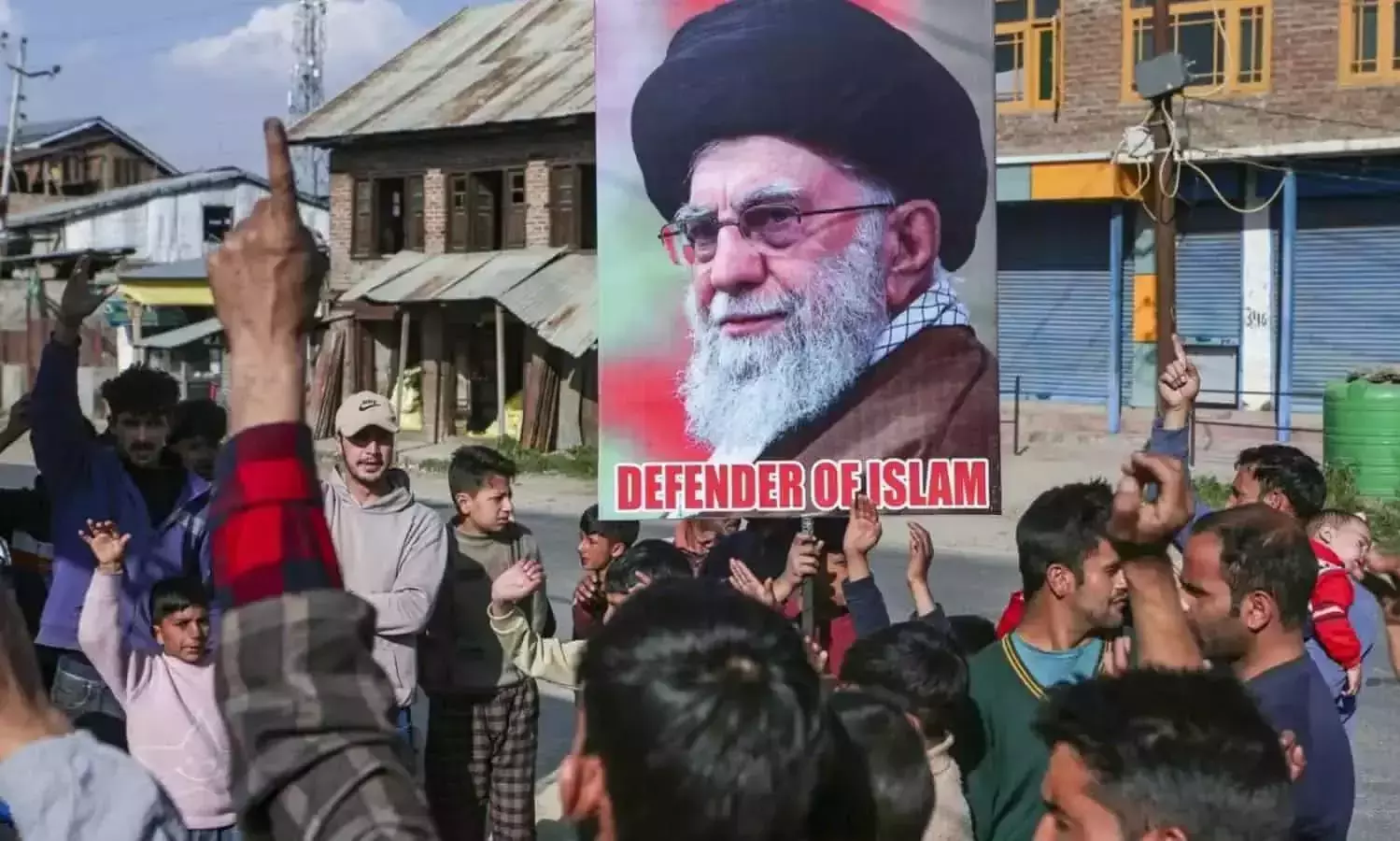

Srinagar: Large protests have erupted in several parts of Kashmir following the killing of Iran’s Supreme Leader, Ayatollah Ali Khamenei, highlighting once again how developments in the Muslim world often resonate strongly in the Valley.
Demonstrations were reported earlier this week in Shia-dominated areas of Srinagar, Budgam and Bandipora, where large crowds gathered on the streets raising slogans against the United States and Israel while expressing solidarity with Iran’s leadership.
The protests reflect a long-standing pattern in Kashmir, where geopolitical developments involving Muslim countries frequently trigger public demonstrations. Over the decades, the Valley has witnessed protests over various international events affecting Muslim communities, including conflicts in Palestine and wars in Iraq and Syria.
One of the most controversial instances occurred in 2011 when hardline separatist leader Syed Ali Geelani organised funeral prayers in absentia for Osama bin Laden, the Al-Qaeda chief killed by US forces in Pakistan. The “gaibana namaz-e-janaza” held in Srinagar was echoed in several mosques across the Valley, underscoring how events far beyond Kashmir’s borders can mobilise political and religious sentiment locally.
More recently, protests broke out in parts of Kashmir and Ladakh in 2020 after Iranian military commander Qasem Soleimani was killed in a US drone strike in Baghdad. Demonstrations were particularly strong in Shia-majority areas.
Analysts say such reactions are rooted in a complex mix of historical ties, religious identity and political sentiment. For centuries, Kashmir maintained deep cultural and intellectual connections with Iran and Central Asia, with Persian once serving as the language of administration and scholarship in the region.
Shia communities in parts of central Kashmir also developed close theological and cultural ties with Iran.
Aga Syed Yosuf, a political leader from Budgam, said that the reactions were largely emotional because people there felt a deep religious and historical connection with Iran and other parts of the Muslim world.
Observers say the Valley’s own political history has further reinforced this sentiment, often linking local political narratives with broader struggles involving Muslim communities worldwide.
Based on DH story