














Notices asking non-Christians to ‘enter at own risk’ put up at Chhattisgarh churches
text_fields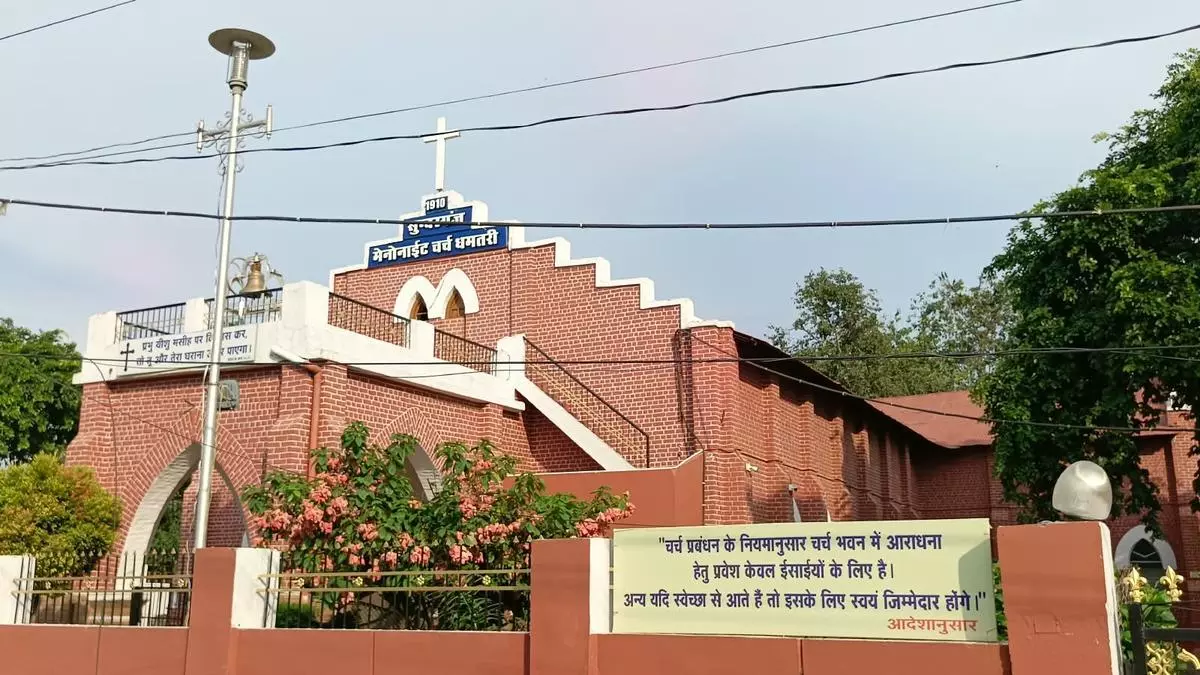

Raipur: More than 10 churches in Chhattisgarh’s Dhamtari district have put up notices asking non-Christians to enter their premises at their own risk, amid concerns over possible backlash from Hindutva groups following the implementation of the state’s new anti-conversion law.
The notices have been displayed over the past month, including outside the 125-year-old Sunderganj Mennonite Church in Dhamtari. One notice states that, under the rules, only Christians are allowed to enter the church for prayers and that those who enter voluntarily would be responsible for their decision.
The warnings have also been put up outside some homes where members of the Christian community hold prayer meetings.
Diamond Filus, general secretary of the Dhamtari District Christian Forum, told The Indian Express that the notices were put up as a precautionary measure and that community members had been asked to display them at places where people gather for prayers.
The move followed the submission of more than 1,000 self-declaration forms by non-Christians to the district administration, stating that they were attending churches for prayers voluntarily, according to the Christian forum. A community leader said the applications had angered some right-wing members.
The declarations were submitted after Chhattisgarh’s stringent new law aimed at preventing unlawful religious conversions came into force last month. One provision requires a person intending to change their religion to submit a declaration to the competent authority.
The law does not specifically prohibit non-Christians from casually visiting churches. However, community leaders said they were taking precautions amid concerns over the potential consequences of such visits.
Dhamtari, like other parts of the neighbouring Bastar region, has witnessed communal tensions linked to allegations of religious conversion during prayer meetings and disputes over the final rites of people who have converted, according to the report.
Filus alleged that since the Bharatiya Janata Party returned to power in Chhattisgarh in 2023, right-wing activists had been given a “free hand”. He alleged that prayer meetings at churches had been disrupted and claimed that police officials had tried to discourage such groups but had not taken strict action.
He said the decision to put up the notices was initially taken more than a month ago after non-Christian visitors began submitting self-declarations to government authorities stating that they were attending prayers of their own choice.
The measure was subsequently implemented more strictly after a September 15 meeting at the Dhamtari Collectorate, Filus said.

He said more than 1,000 people had submitted such declarations, following which the Christian community decided to put up the notices as a precaution.
A peace meeting was also convened by Dhamtari police on September 15. Filus said members of the Bajrang Dal and the tribal organisation Sarva Adivasi Samaj objected to non-Christians attending prayer meetings and told the Christian community that they should not allow them to do so. He said the Christian representatives had not been informed beforehand that members of these groups would attend the meeting.
Filus said the community had initially wanted to boycott the meeting but remained after police officials requested them to stay. He alleged that right-wing members had used abusive language in the past and said the Christian community wanted to avoid confrontation.
He also questioned how churches could prevent non-Christians from attending prayers if they chose to do so voluntarily, and said constitutional values relating to freedom of religion were not upheld at the meeting.
Following the meeting, the Christian community again asked its members to put up the notices outside their premises as a precautionary measure.
Shivnarayan Pandey, a spokesperson for the ruling BJP in Chhattisgarh, rejected the framing of the issue as one involving the political right or left. He said the state government had enacted the law and that groups involved in religious conversion were opposing it.
Pandey described the matter as a social rather than political issue, saying the tribal community opposed religious conversion because it believed it divided people. He also claimed that conversions led tribals to give up their culture and contributed to tensions within the community.