












Kolkata Muslim colony faces water crisis amid court battle over eviction
text_fields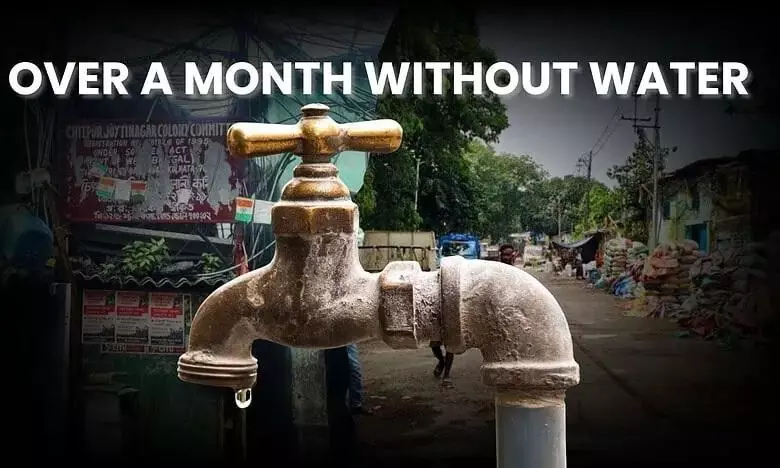

Kolkata: A prolonged water shortage has intensified uncertainty for nearly 5,000 people living in Jyotinagar Colony in Cossipore, where residents are also facing the prospect of eviction from land claimed by the Shyama Prasad Mukherjee Port.
The colony has had no municipal tap water since July 29, according to residents. Its five public taps, which earlier functioned for much of the day, have remained dry for nearly eight weeks.
Most of the colony’s residents are Muslims employed as daily wage workers, masons, rickshaw pullers and factory labourers. The shortage has forced families to depend on distant water sources, private tanks and periodic supplies from a tanker arranged by the CPI(M).
Residents said the crisis began after the Kolkata Municipal Corporation carried out work on a water pipeline between July 26 and 28. They alleged that excavation at both ends of the colony disrupted the supply to a roughly 150-metre stretch, although taps outside the affected section continued to function.
The residents said they complained to municipal officials both orally and in writing, but no official inspection was carried out. Electricity was also disconnected around the same time and restored only after about 10 days.
The shortage has placed an additional burden on women, children and elderly people, who often have to carry water from faraway locations. Some families have reportedly been using muddy water from the Ganges, while others have expressed concern about illnesses and skin infections among children.
The tanker arranged by the CPI(M) arrives once every two or three days, but residents say the quantity is insufficient for the colony’s needs. Those who can afford it have purchased water tanks, leaving poorer households with fewer options.
The water crisis has unfolded amid an ongoing legal dispute over the colony’s land. The settlement covers around 3,478 square metres of land claimed by the Shyama Prasad Mukherjee Port.
The port’s estate officer ordered the residents to vacate the area on February 23 under the Public Premises Act, 1971. Residents said they learnt about the order only on June 9 and alleged that they were not given adequate notice or an opportunity to present their case.
The City Civil Court rejected their plea for relief on August 18. A day later, the Calcutta High Court stayed the eviction process on an interim basis. The port authority has argued that the colony is overcrowded and unsafe and that its occupation has caused financial losses.
With the case still pending, residents and local activists have questioned why basic water services have not been restored if the disruption was caused only by pipeline work.
They have also alleged that the deprivation is part of an attempt to pressure residents into leaving and have raised concerns over the treatment of the colony’s predominantly Muslim population.
Saraswati Biswas, a Hindu resident who has lived there for nearly six decades, rejected allegations that residents were outsiders.
“How did I become a Bangladeshi? My ancestors lived here, I have complete Indian documents, and I even voted this year” she asked.
Residents have also alleged that local BJP MLA Ritesh Tiwari had said he would not work for Muslims after taking office. Tiwari has said the land belongs to the port and that the matter is before the court, arguing that he has no role in the dispute.
Residents and activists have compared the situation with the displacement of Bengali-origin Muslim families in Assam’s Dhubri district in July 2025. Homes belonging to about 1,400 families were demolished during an eviction drive, reportedly affecting nearly 10,000 people.
The land, spread across approximately 1,157 acres, was later used for a 3,200 MW thermal power project involving Adani Power. The government described the demolitions as action against illegal encroachments, while displaced families said they had lived there for decades and had not received rehabilitation.
In Jyotinagar, residents now face both the loss of access to a basic necessity and the possibility of losing their homes. They are demanding the immediate restoration of water supply and protection from eviction until the High Court decides the case.