















Mass disenfranchisement a ‘negation of constitutional order’: Justice Ujjal Bhuyan
text_fields

Hyderabad: Supreme Court judge Justice Ujjal Bhuyan on Sunday said any process that results in the disenfranchisement of millions of Indian citizens is “intrinsically arbitrary” and amounts to a negation of the constitutional order.
Delivering the valedictory address at the 19th NALSAR-Justice B.R. Sawhney Memorial Moot Court Competition at NALSAR University of Law here, Justice Bhuyan said the Constitution does not envisage two classes of citizens — those with voting rights and those without them.
“If any process results in disenfranchising millions and millions of Indian citizens, making them second-class citizens in their own country in the sense of being citizens without voting rights, such a process is intrinsically arbitrary. No amount of whataboutery can justify it,” he said.
Justice Bhuyan said such an exercise would strike at the heart of the Constitution and would violate Article 14, which guarantees equality before the law, and Article 326, which provides for elections based on universal adult suffrage.
“I would go to the extent of saying that it is a negation of the constitutional order which we have adopted under the Constitution of India,” he said.
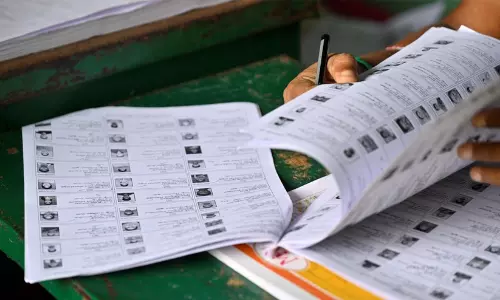
He did not name any particular electoral exercise or authority during his address. His remarks, however, come amid political and legal debate over the Election Commission’s Special Intensive Revision (SIR) of electoral rolls and concerns over large-scale deletion of names.
Justice Bhuyan said the right to vote could not be separated from the status of an Indian citizen.
“From the persona of an Indian citizen, the right to vote or the right to be included in the voters’ list cannot be detached. It will be like taking out the soul from the body,” he said.
He said the Supreme Court had held that voting was not a fundamental right but a constitutional right flowing from Article 326. In his view, the right of an Indian citizen to cast a vote was central to the basic structure of the Constitution.
Justice Bhuyan said the right to vote was intertwined with India’s long struggle against colonial rule and was a manifestation of the freedom achieved through sacrifice.
“Article 326 cannot be tinkered with at all. No authority can do it; no court can condone it. No one is above the Constitution,” he said.
He also stressed that, except in the case of a deceased voter, the name of a person already included in an electoral roll could not be deleted without notice and an opportunity of hearing.
Justice Bhuyan described universal adult franchise as the Constitution-makers’ “act of faith” in ordinary citizens, under which the vote of a billionaire and that of a rickshaw-puller carried equal value.
“One may be a billionaire, and one may be a rickshaw puller; yet both will have their votes, and the value of their votes would be equal,” he said.
Citing former US Supreme Court judge Felix Frankfurter, Justice Bhuyan said the highest office in a democracy was that of the citizen. He also quoted Frankfurter as saying that democracy was “always a beckoning goal, not a safe harbour”, as freedom required constant effort and could never be treated as a final achievement.
“And what is the worth of a citizen without her voting right?” Justice Bhuyan asked.
(With inputs from IANS)