















In 2nd increase in under a week, petrol, diesel prices rise by 90 paise per litre
text_fields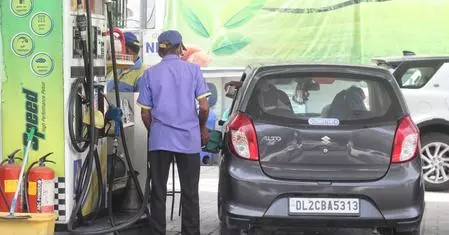

New Delhi: Public sector oil marketing companies (OMCs) on Tuesday increased petrol and diesel prices by 90 paise per litre each, marking the second fuel price hike within a week as companies continued to face mounting financial pressure amid the ongoing West Asia crisis.
Following the latest revision, petrol prices in Delhi rose to Rs 98.64 per litre, while diesel prices climbed to Rs 91.58 per litre, with corresponding variations across states because of differing local taxes, Indian Express reported.
The increase came after a Rs 3-per-litre hike announced on Friday, which had been the first rise in fuel prices in over four years. According to the Ministry of Petroleum and Natural Gas, the earlier increase reduced the combined daily losses of OMCs on petrol, diesel and LPG sales by roughly Rs 250 crore, bringing estimated daily losses down to about Rs 750 crore.
Industry analysts said that Friday’s hike only partially eased the burden because the gap between retail fuel prices and international market-linked prices remained substantial. More gradual and calibrated increases had therefore been expected after the initial revision.
Sehul Bhatt, director, Crisil Intelligence had stated that the Rs 3 increase, combined with a slight softening in crude oil prices, had reduced estimated under-recoveries to around Rs 10 per litre for petrol and Rs 13 per litre for diesel. However, he cautioned that the financial pressure on OMCs remained significant and suggested that the recent hikes reflected an acknowledgement that the absorbed costs would eventually need to be passed on to consumers.
Global crude oil prices have surged by more than 50% because of the conflict in West Asia and disruptions linked to the closure of the Strait of Hormuz. Despite this, government-owned fuel retailers had not raised domestic petrol and diesel prices for four years, apart from a reduction announced ahead of the 2024 Lok Sabha elections.
Discussions within the government on raising fuel prices had intensified in recent weeks, with officials concluding that an increase had become unavoidable. Sources indicated that the timing of the global energy surge coincided with Assembly elections in several states, making fuel price hikes politically sensitive. After the elections concluded, a price revision was considered more feasible. Earlier in May, a senior government official had reportedly described a hike as inevitable.
Although retail petrol and diesel prices are officially deregulated, the government-owned OMCs, which account for nearly 90% of India’s fuel retail market, have generally maintained price stability in consultation with the government. This has meant that the companies absorbed losses when global crude prices rose and benefited during periods of lower oil prices.
Industry sources also suggested that a sharp one-time increase could have triggered political backlash and inflationary shocks. Gradual hikes, they argued, allowed the government to monitor public response and manage inflationary pressures more carefully.
Fuel prices directly affect the Consumer Price Index and also influence inflation indirectly through higher transportation, logistics and industrial input costs.
The crisis has reportedly placed OMCs under severe financial strain. Last week, Petroleum Minister Hardeep Singh Puri stated that the combined losses of the three state-run refiners and fuel retailers could reach Rs 1 lakh crore during the April–June quarter at current price levels, potentially wiping out their entire profits for the 2025–26 financial year.
The Union government had earlier reduced excise duty on petrol and diesel by Rs 10 per litre in late March to ease pressure on OMCs. However, fuel retailers continued to incur losses, while the excise cut is estimated to have reduced government revenue by around Rs 14,000 crore every month.
Although India has managed to secure sufficient crude oil supplies from non-Gulf sources, refiners have reportedly faced sharply higher costs due to emergency spot-market purchases as well as rising shipping and insurance expenses. Amid uncertainty over the duration of the crisis, Narendra Modi recently appealed for conservation of petroleum products in an effort to moderate imports and reduce foreign exchange outflows.
India’s crude oil basket, which averaged about $70 per barrel last year, reportedly rose to over $114 per barrel in April and has averaged around $107 per barrel so far in May. Analysts warned that if prices remain near $100 per barrel throughout the fiscal year and import volumes do not decline, India’s oil import bill could exceed $200 billion in 2025–26.