
















Great Indian Bustard population stable, but species now survives in only 16% of Thar habitat
text_fields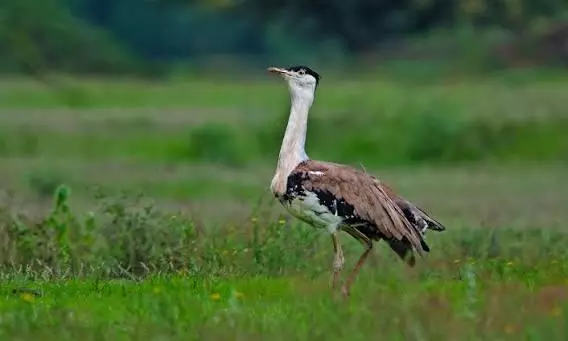

The population of the critically endangered Great Indian Bustard (GIB) has remained stable at an estimated 110–150 birds, according to the first official assessment in seven years.
The report, released by the Union Environment Ministry on Thursday, estimates the current population at 130 birds (±21) and says numbers have not declined since the previous survey conducted in 2017–18.
Despite the stable population, the assessment warns that the species now occupies only 16% of its potential habitat in Rajasthan's Thar Desert.
The survey, conducted by the Wildlife Institute of India (WII) in collaboration with the Rajasthan Forest Department, covered the bird's remaining range in Rajasthan, where the vast majority of the surviving population is found. Gujarat, where only a handful of female bustards remain in the wild, was not included in the assessment.
Researchers recorded 35 Great Indian Bustard flocks, 1,568 chinkara herds, and 79 desert foxes during the 2024–25 survey, along with non-native species such as nilgai, wild pigs and free-ranging dogs.
The report identifies habitat fragmentation, expanding infrastructure, and collisions with power transmission lines as the biggest threats to the species. Bustards are especially vulnerable to overhead power lines because of their poor frontal vision, making collisions a leading cause of mortality. Renewable energy projects, roads, fencing, and agricultural expansion have further reduced suitable habitat.
The remaining stronghold for the species lies in and around Desert National Park and the Pokhran Range in Jaisalmer, where relatively undisturbed grasslands still provide favourable breeding and feeding grounds.
To reduce threats, the Supreme Court last year ordered the creation of dedicated power-line corridors, rerouting of overhead transmission lines, and the underground laying of cables in priority conservation areas.
The report also highlights ongoing conservation efforts under Project Great Indian Bustard, which include habitat restoration, predator management, protection of wild nests and a captive breeding programme at Sam and Ramdevra in Jaisalmer. Eggs collected from the wild are being raised in controlled facilities, with plans to release captive-bred birds into the wild in the coming years.
Besides the Great Indian Bustard, the Thar Desert also supports several other important species, including the chinkara, desert fox, Indian fox, desert cat, spiny-tailed lizard, and a range of birds of prey.