


Ex-CJI Chandrachud calls Babri Masjid erection a desecration, critics allege bias
text_fields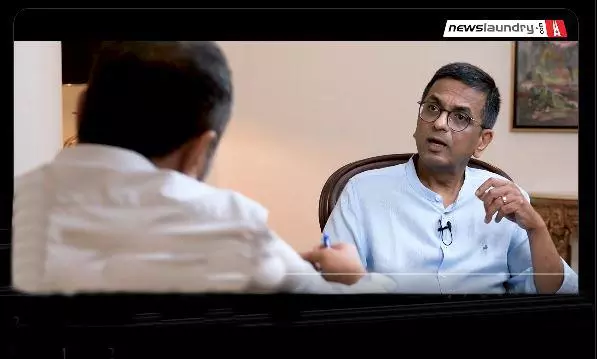

Former Chief Justice of India, DY Chandrachud, who was part of the bench that granted Babri Masjid land to Hindu petitioners and who had faced criticism for claiming to seek God’s counsel for the same verdict, contradicted the judgment by suggesting that a temple once stood under the Babri Masjid and that the Masjid's construction was a desecration, despite no evidence to support this claim, reflecting a bias in favour of his Hindu belief rather than impartiality while holding a constitutional post.
In an interview with Sreenivasan Jain of Newslaundry, Chandrachud said, “The erection of the Babri Masjid in 1528 was itself a fundamental act of desecration of a site believed by Hindus to be Lord Ram’s birthplace,” framing the historical narrative in a way that aligned with Hindutva ideology while defending the bench’s decision, and he insisted that the 2019 Ayodhya verdict, which paved the way for the construction of a Ram Temple, was grounded in legal evidence rather than religious sentiment.
He elaborated that the judgment, running to 1,045 pages, examined archaeological reports, historical texts, traveller accounts, and revenue records, and concluded that the underlying structure beneath the Babri Masjid indicated a pre-existing Hindu temple, claiming, “This wasn’t about belief, it was about facts presented before us,” and emphasising that the alternative allocation of a five-acre plot for a mosque was to maintain the balance.
Chandrachud also addressed the controversy over his remarks about seeking guidance from God in difficult cases, defending his approach as a personal reflection on moral responsibility in the judiciary rather than a compromise of secular principles, and he stated that judges must remain impartial while acknowledging their human limitations in polarised times.
Chandrachud also justified allowing the videographic survey of the Gyanvapi Mosque despite the Places of Worship Act of 1991, which freezes the religious character of sites as of August 15, 1947, by arguing that evidence must guide judicial interventions and that the survey was conducted to determine the reigious character of the structure within legal parameters.
Observers, however, argued that Chandrachud’s repeated public statements reflect a judicial approach that favours Hindu claims, while critics, including former judges and senior advocates, have raised concerns that such remarks compromise India’s secular fabric and suggest an alignment with Hindutva ideology rather than constitutional neutrality.
Several commentators noted that calling the Masjid construction a historical desecration without conclusive evidence undermines the claim of impartiality, and that Chandrachud’s public interventions, combined with roster decisions during his tenure, often aligned with the ruling party’s interests, raising questions about the independence of his judicial philosophy.
The 2019 Ayodhya verdict remains one of the most scrutinised rulings in Indian judicial history, and while the former chief justice insisted that the allocation of land to Hindu parties was based on title suits, critics have point out that the judgment - by the bench presided by Chief Justice Ranjan Gogoi and Chandrachud as one of the five judges - alongside the Gyanvapi survey, reflects a pattern in which faith-based interpretations appear to override empirical evidence, and that such decisions could embolden future judges to settle religious disputes in similar manner despite the constitutional principle of secularism.
Analysts also observed that Chandrachud’s tenure as Chief Justice, which included landmark decisions on same-sex marriage petitions and transparency in electoral bonds, demonstrates both liberal legal reasoning and instances of controversial alignment with political considerations.
They further suggested that what is often portrayed as progressive or liberal jurisprudence in India may in fact be a performance that masks alignment with religious nationalist ideologies, and Chandrachud’s statements on Babri Masjid and Gyanvapi Mosque have reinforced perceptions that personal belief and ambition may influence judicial conduct.