












Centre weighs fresh delimitation plan with uniform 50% increase in seats across states
text_fields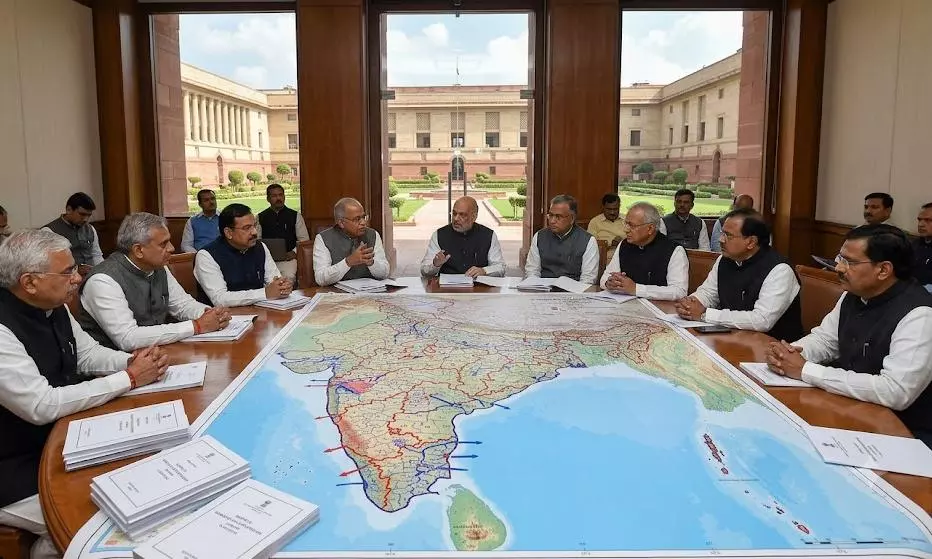

The BJP-led National Democratic Alliance (NDA) government has, on several occasions in recent years, struggled to secure the parliamentary numbers required to pass key constitutional amendments, suffering setbacks in both Houses whenever crucial legislation demanded a special majority.
Mindful of those setbacks, the ruling alliance has since sought to reinforce its numerical strength in Parliament, attracting legislators from opposition parties in an apparent effort to secure the numbers necessary for the passage of future constitutional amendments.
A report published by The Wire suggests that the contours of a renewed delimitation proposal are already being prepared, envisaging the division and reorganisation of parliamentary constituencies alongside a uniform 50 per cent increase in Lok Sabha seats across all States.
In the months that have followed, the Government has simultaneously sought to consolidate its parliamentary position, with a succession of defections from opposition parties adding to the strength of the ruling benches.
Against that political backdrop, reports published by The Wire suggest that preparations are now under way for the reintroduction of a revised delimitation proposal, intended to overcome the objections that contributed to the Bill's defeat and to command broader political acceptance.
At the centre of the emerging proposal lies the assurance that every State would receive a uniform increase of 50 per cent in its representation in the Lok Sabha, thereby preserving the existing proportion of seats amongst the States while enlarging the strength of the House.
Such an assurance, articulated publicly by the Telugu Desam Party, an important constituent of the ruling alliance, is regarded as an attempt to allay apprehensions, particularly amongst the southern States, that a fresh population-based redistribution would diminish their parliamentary influence despite decades of successful population control.
The debate has acquired further significance following the publication of a working paper by the Economic Advisory Council to the Prime Minister, which advocates what it describes as a "targeted" approach to delimitation.
Rather than relying exclusively upon demographic redistribution, the paper proposes the division of 170 existing parliamentary constituencies into two or three segments, increasing the membership of the Lok Sabha from its present strength of 543 to 824.
The study contends that such an exercise, accompanied by rationalisation of polling arrangements, could produce higher electoral participation, particularly amongst women voters.
Constitutional scholars, however, have counselled caution. K. Ashok Vardhan Shetty, a member of Tamil Nadu's High-Level Committee on Union-State Relations, has argued that a uniform increase may preserve the existing federal balance, yet cannot by itself resolve the constitutional consequences arising from the eventual removal of the freeze upon seat allocation based on the 1971 Census.