











Catholic union urges govt to address issues behind violence against Christians
text_fields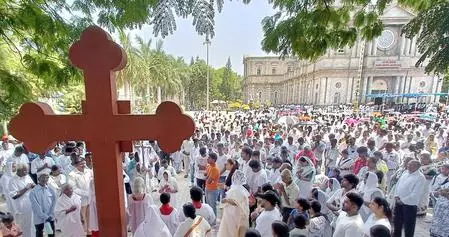

New Delhi: The All India Catholic Union has reiterated its call to the Union government to address issues that contribute to violence against Christians in India, particularly during Christmas celebrations.
The AICU represents the Catholic laity in 120 Diocesan units throughout the country. It stated in a statement that attacks have escalated in areas including Uttar Pradesh, Chhattisgarh, and Madhya Pradesh, with monitoring groups documenting hundreds of events, including assaults, disruption of worship, and the misuse of anti-conversion laws.
While the union welcomes symbolic actions by national leaders, it believes they are insufficient without real action, accountability, and legal reform. It attacked hate speech and NGOs' limits under the Foreign Contribution (Regulation) Act, and urged for a charter in 2026 to defend constitutional rights, minority welfare, and India's secular ethos, the Wire reported.
“The violence and hate experienced by Christians in India throughout 2025, especially during the Christmas season, represent not only attacks on individuals but also on the pluralistic fabric of Indian society.
Addressing these challenges requires honest acknowledgement, genuine political will, and united grassroots action. As we step into 2026, the All India Catholic Union [AICU], 106 years old and speaking for common Christians in the country, sees this as both a solemn reminder and a hopeful call to action. “Together, through unity, education, and principled advocacy, we can strive to create an India where diversity is celebrated and every citizen’s rights are protected against hate and discrimination,” AICU National President Er. Elias Vaz said.
The statement further said that India’s Christian community, particularly in states such as Uttar Pradesh, Chhattisgarh, Madhya Pradesh and Odisha, has had a troubling year in 2025, marked by continued reports of violence and intimidation. Accounts from monitoring agencies and media outlets indicate that incidents remained high, with a noticeable rise during the Christmas season, when more than 20 cases were reported across northern India.
The scale of the problem is reflected in figures compiled by the United Christian Forum, which recorded 706 incidents between January and November 2025. Comparable findings were reported by the Evangelical Fellowship of India, with significant numbers emerging from Uttar Pradesh and Chhattisgarh. These incidents ranged from physical assaults and disruptions of religious gatherings to vandalism and allegations of forced conversions.
In some regions, posters calling for boycotts of Christmas appeared, while vendors selling festive items were reportedly threatened. Media reports also highlighted disruptions at dozens of events nationwide, including attacks on carol singers in Kerala, damage to Christmas decorations in Chhattisgarh malls, and harassment of worshippers in Madhya Pradesh, including an episode involving a BJP leader confronting a visually impaired woman.
It was also noted that Vice President C.P. Radhakrishnan attended celebrations organised by the Catholic Bishops Conference of India and hosted a gathering for Catholic and Protestant bishops, while Prime Minister Narendra Modi visited a cathedral in New Delhi during Christmas services. Although these gestures were welcomed, community leaders have stressed that symbolic participation is not enough. They argue that firm and effective action is required to protect minorities and that there has been little indication of such measures being taken.
According to the statement, the hostile environment is part of hate speech and xenophobic rhetoric by certain political leaders and affiliated groups, which they say has encouraged vigilante actions. They also point to the frequent misuse of anti-conversion laws in several states, alleging that these are often invoked to harass Christians despite minimal evidence of coercion.
According to observers, official responses have fallen short of the gravity of the situation, with those responsible for violence rarely facing prosecution.
Beyond physical attacks, the community faces other forms of pressure. Restrictions under the Foreign Contribution (Regulation) Act continue to affect Christian organisations involved in education and welfare, with many NGOs reportedly experiencing delays or cancellations of licences that limit their operations.
Community representatives emphasise the importance of unity among Christians and other minorities, as well as greater awareness of constitutional rights and responsibilities, particularly in light of issues such as electoral roll revisions, the upcoming census and wider economic challenges.
In response, the All India Catholic Union calls for a New Year Charter in 2026 that includes:
• Programmes to educate citizens on rights under Articles 25-28 of the Constitution.
• Measures to prevent manipulation of electoral rolls affecting minorities.
• Ensuring the census does not deepen divisions.
• Restoration of FCRA licences for genuine NGOs.
• Ending interference in Christian schools, such as pressure over holidays or curricula.
Christians, who constitute around 2.3% of India’s population, are widely recognised for their contributions to education and healthcare. Community leaders underline that they are seeking only the equal rights guaranteed to all citizens, stressing that the current situation highlights an urgent need for change and a renewed commitment to India’s secular values.