


















Astronomers detect violent exoplanet collision 11,000 light-years away
text_fields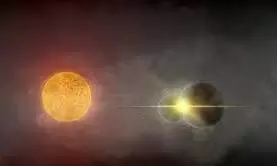

Astronomers have gathered evidence of a violent collision between two exoplanets in a distant star system about 11,000 light-years from Earth after observing unusual behaviour from a Sun-like star.
The star, known as Gaia20ekh, is located near the constellation Puppis.
Researchers first noticed something unusual when the star’s brightness began fluctuating unexpectedly.
According to Tzanidakis, a doctoral candidate at the University of Washington, the star initially appeared stable before the changes began.
“The star’s light output was nice and flat, but starting in 2016, it had these three dips in brightness. And then, right around 2021, it went completely bonkers,” he said, adding that stars similar to the Sun normally do not show such behaviour.
Further investigation revealed that the star itself did not cause the dimming. Instead, astronomers found that large amounts of rocks and dust were passing in front of the star, blocking part of its light as seen from Earth.
Scientists concluded that the debris likely came from the collision of two planets orbiting the star. As the material moves around the system, it periodically passes between Earth and the star, causing temporary drops in brightness.
Researchers say telescopes were able to capture the aftermath of the impact in real time, making the discovery particularly rare. Only a few planetary collisions have ever been recorded, and none have shown such close similarities to the event believed to have formed the Moon around Earth about 4.5 billion years ago.
The debris cloud produced by the collision is estimated to be about 93 million miles wide, roughly the same distance between the Earth and the Sun.
Astronomers say observing more events like this could provide valuable insights into how planets form and evolve across the galaxy.