









Maduro’s US trial: Venezuela leader faces Noriega-style legal battle over immunity
text_fields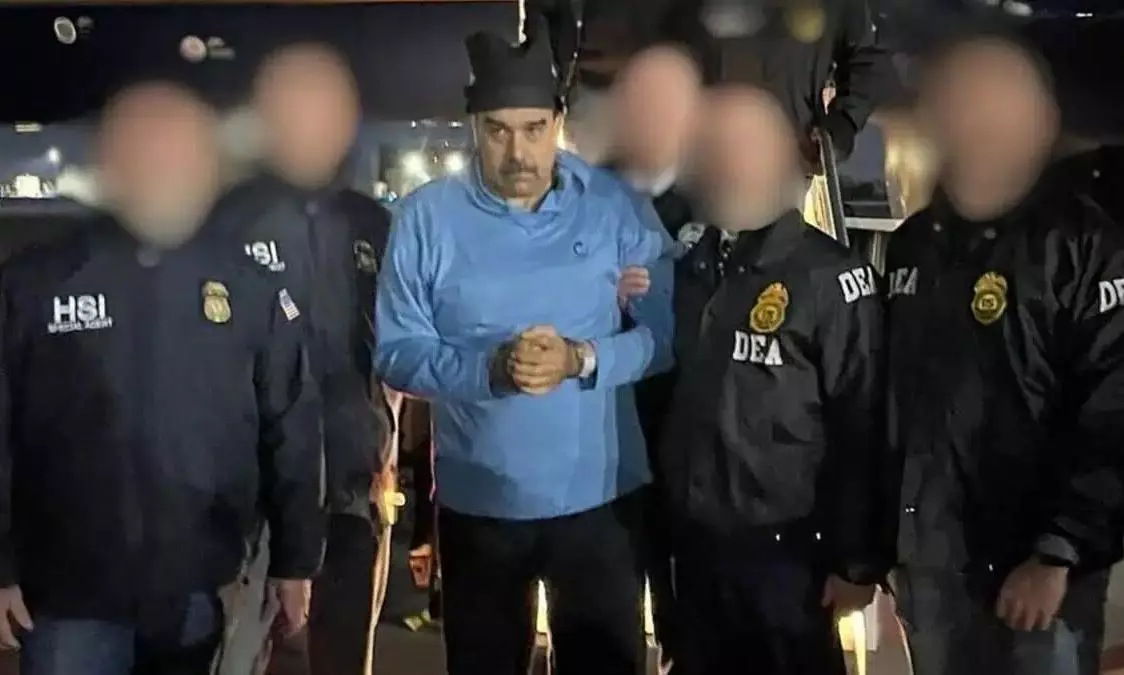
Venezuela President Nicolás Maduro arrives in New York to face trial after capture

When deposed Venezuelan leader Nicolás Maduro appears in a New York courtroom on Monday to face narcotics charges, his legal trajectory will likely mirror that of Panama’s Manuel Noriega, another Latin American strongman removed by American troops three decades ago.
Captured exactly 36 years after Noriega’s ousting, Maduro represents a high-stakes test of international law. His legal team is expected to challenge the arrest immediately, arguing that as a sitting head of state, he holds sovereign immunity, a fundamental principle of global diplomacy.
However, legal experts suggest this defence is doomed to fail, largely because the legal groundwork was established during Noriega’s prosecution. While the lack of congressional authorisation for the Venezuela operation raises constitutional questions, US courts are expected to validate the prosecution on the grounds that Washington does not recognise Maduro as Venezuela's legitimate president.
"There’s no claim to sovereign immunity if we don’t recognise him as head of state," noted Dick Gregorie, the retired federal prosecutor who indicted Noriega. "Several US administrations, both Republican and Democrat, have called his election fraudulent and withheld US recognition. Sadly, for Maduro, it means he’s stuck with it."
Noriega, who died in 2017 after spending nearly 30 years in prison across three countries, unsuccessfully argued that his arrest via invasion was "shocking to the conscience" and violated due process.
The legal justification for Maduro’s removal rests heavily on a 1989 opinion by Bill Barr, written six months before the Panama invasion. It asserts that the UN Charter does not prohibit the US from conducting "forcible abductions" overseas to enforce domestic laws, a stance supported by Supreme Court rulings dating back to the 19th century.
Barr, who served as attorney general during the first Trump administration and oversaw Maduro's indictment, defended the strategy on Sunday. Dismissing claims that the operation was purely about regime change, he told Fox News: " The object here is not just to get Maduro. It’s to clean that place out of this criminal organisation."
Despite the parallels, Maduro’s case has distinct complexities. Unlike Noriega, who ruled through puppet presidents, Maduro claims three electoral victories. Although his 2024 re-election is widely disputed, he retains recognition from major powers including China and Russia.
"Maduro has a much stronger sovereign immunity defence than did Noriega," argued Miami defence lawyer David Oscar Markus. "Before you ever get to guilt or innocence, there are serious questions about whether a US court can proceed at all."
Ultimately, however, US courts typically defer to the State Department on foreign policy matters. The US government has considered Maduro a fugitive for years, offering a $50 million reward for his capture and formally recognising the opposition leadership since 2019.
Maduro faces immediate logistical challenges, primarily hiring counsel. Both he and his wife, Cilia Flores, are under heavy sanctions, making it illegal for US lawyers to accept payment without a specific Treasury Department licence.
The prosecution will likely cite the case of Juan Orlando Hernández, the former Honduran president convicted of drug trafficking in 2024, as proof that foreign leaders are not untouchable. Although Maduro might attempt to argue for limited immunity regarding "official acts" taken while in power, experts believe this will not cover the charges against him.
The indictment accuses Maduro’s inner circle of facilitating the transport of thousands of tonnes of cocaine. "The government will argue that running a big narco-trafficking operation … should not count as an official act," said Curtis Bradley, a former State Department legal counsellor.
(Inputs from AP)