















Bangladesh election: BNP claims historic win, PM Modi congratulates Tarique Rahman
text_fields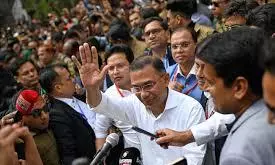

The Bangladesh Nationalist Party (BNP) has claimed a sweeping victory in the country’s first national election since the overthrow of former prime minister Sheikh Hasina, marking its return to power after 20 years.
Preliminary results on Friday showed the BNP leading decisively, with election commission figures indicating the party had secured 181 seats by around 9 am local time. BNP leaders said they were confident of winning about 200 seats, enough for a two-thirds majority in parliament.
Party chief Tarique Rahman is expected to become the next prime minister.
Indian Prime Minister Narendra Modi congratulated him on X, calling the result a decisive victory that reflected public trust in his leadership, and said India would continue to support a democratic, progressive, and inclusive Bangladesh.
Rahman returned to Bangladesh in December after 17 years in exile in London and is the son of former prime minister Khaleda Zia and former president Ziaur Rahman, who was assassinated in 1981.
His return and expected elevation to prime minister came after a student-led uprising in August 2024 that ended Hasina’s 15-year rule. The protests were driven by anger over widespread corruption, human rights abuses, and an economic downturn.
The vote was widely regarded as the country’s first free and fair election in nearly two decades and followed years of political turmoil under Hasina’s rule. Salahuddin Ahmed, a senior BNP leader, said the outcome reflected public confidence in a party capable of rebuilding the country after years of repression and corruption, adding that the challenges ahead required restraint rather than celebration.
More than 2,000 candidates, including many independents, contested the election, with at least 50 parties on the ballot, the highest number in the country’s history.
The Islamist party Jamaat-e-Islami and its allies won 61 seats, their strongest parliamentary showing to date. Jamaat chief Shafiqur Rahman conceded defeat and said his party would pursue constructive politics, though the party later alleged irregularities in closely contested constituencies.
The election was largely peaceful, with preliminary data showing voter turnout at 60.69%, significantly higher than the previous election. It was also the first vote to allow overseas Bangladeshis to participate.
Hasina’s Awami League was barred from contesting the election and called for a boycott. Human rights groups and the United Nations have documented widespread repression during her 15-year rule, including enforced disappearances, torture, and killings. Hasina fled to India after being removed from power and was later sentenced to death by a war crimes tribunal for crimes against humanity. She has denounced the election as a farce held without genuine participation.
Alongside the parliamentary vote, a referendum on constitutional reforms – including a neutral interim government during elections, judicial reforms, and a two-term limit for prime ministers – appeared to have passed with more than 60% support, according to early counts.
Bangladesh, a Muslim-majority nation of about 175 million people, now faces the challenge of restoring democratic institutions, maintaining stability, and reviving economic growth.
Rahman has called for a reset in relations with India, pledging cooperation on counterterrorism, water-sharing agreements, and Hindu minority protection, even as questions remain over how closely Dhaka will align with New Delhi under the new government.
He acknowledged that there were “issues” in the bilateral relationship and said he would seek a relationship based on “mutual respect” and “mutual understanding”. When asked about rebuilding ties when New Delhi is providing a safe haven to Sheikh Hasina, he said, "It would depend. It has to be on them too."