













Watershed conjuncture in Bihar politics
text_fields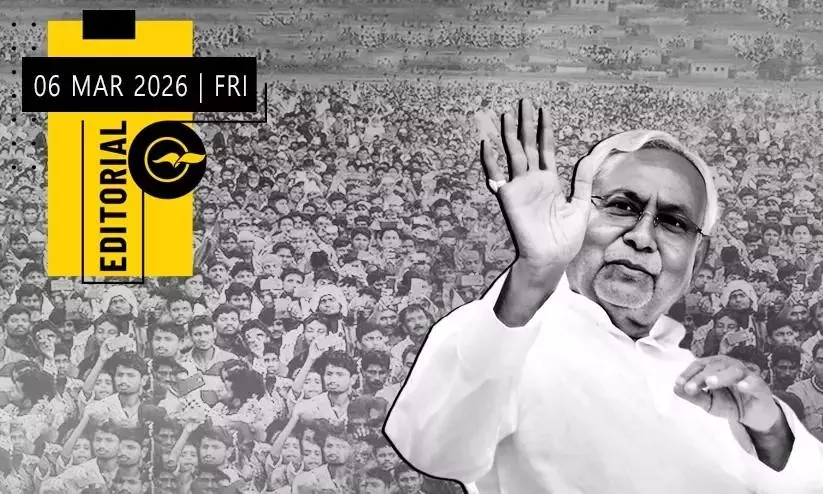

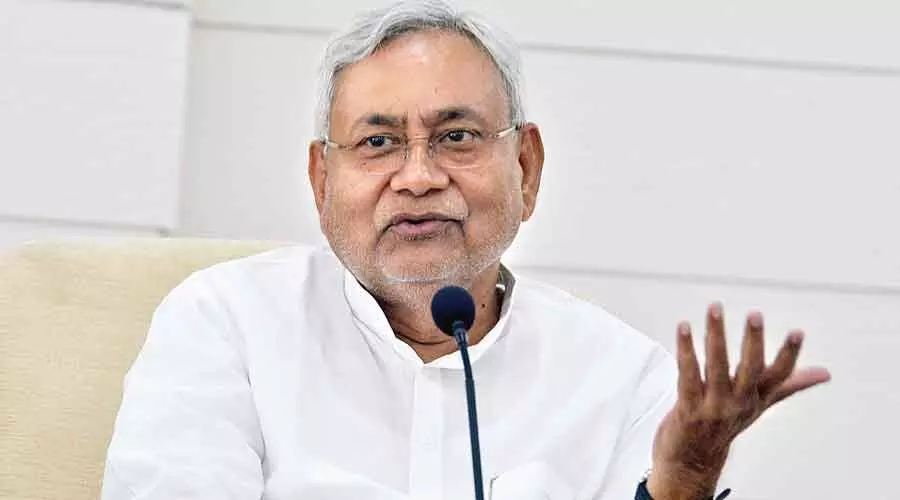
Notwithstanding their repeated ascendance to the seats of governance across more than a score of states and their entrenched hegemony over the vast Hindi Heartland, the Chief Ministerial mantle of Bihar has always remained elusive for the BJP. Yet, that stoic and protracted political wait is finally coming to an end. Nitish Kumar, who for nearly two decades served as the pre-eminent catalyst within the state’s political firmament, has filed nomination papers for the Rajya Sabha relinquishing the Chief Ministerial post. He completed this formality flanked by Union Home Minister Amit Shah, Deputy Chief Ministers Samrat Chaudhary and Vijay Sinha, alongside ministers Vijendra Yadav and Vijay Chaudhary. Also in attendance were the stalwarts of the BJP-JD(U) alliance, such as Nitin Navin, Ramnath Thakur, Upendra Kushwaha, and Shivesh Kumar.
"From the very beginning of my parliamentary journey, there has been a desire in my heart to become a member of both Houses of the Bihar Legislature as well as both Houses of Parliament. In keeping with this aspiration, I seek to become a member of the Rajya Sabha in the elections being held this time." Even his political detractors are inclined to dismiss this recent missive on X (formerly Twitter) as a mere ‘Holi jest.’ Yet the BJP’s acquisition of the seat long occupied by Nitish Kumar transcends a mere transfer of authority; it represents a redrawing in Bihar’s political map. Concurrently, it represents the end of a defining epoch in the state’s political history.

During the era of the Emergency, a cadre of young faces emerged as the acolytes of Jayaprakash Narayan within Bihar’s political arena. Pre-eminent among this cohort were Lalu Prasad Yadav, Sushil Modi, Ram Vilas Paswan, Sharad Yadav, and Nitish Kumar—figures who, for over three decades, exercised a near-total hegemony over the state’s governance. It remains another paradox of Indian statecraft that these disciples of ‘JP’—a man defined by his ascetic renunciation of high office and his unswerving commitment to the populace—transmuted into the grandmasters of the ‘Aaya Ram Gaya Ram’ school of political opportunism. In any junctures of uncertainties of national politics for more than two decades, they functioned as the ultimate arbiters of power, perpetually ensconced at the helm of authority regardless of the prevailing partisan winds. With Nitish Kumar, one of the final vestiges of that seminal generation, vacating the chief ministerial chair, what unfolds is not merely a reconfiguration of power but a profound generational transformation in Bihar’s political lineage. Though he may derive a measure of solace from the purported assurance of his son Nishanth Kumar’s elevation to the deputy chief ministership as part of this succession, for the BJP, this represents an unequivocal triumph of grand proportions. This exultation was palpably manifest in the words of Union Home Minister Amit Shah.

A cogent elucidation as to why Nitish Kumar, a scant four months after his reinvestiture as Chief Minister, has so abruptly stepped down may remain shrouded in ambiguity for some time. Nevertheless, political cognoscenti posit that the present conjuncture represents the most opportune moment for the BJP to effect this displacement and assume the reins of governance. With the nascent administration insulated from the tribulations of the ballot box for the forthcoming three and a half years, they conjecture that by systematically courting Bihar’s populace—specifically the Kurmi, OEC, and OBC demographics that constitute Kumar's electoral bedrock—they might secure an enduring hegemony. There exists a calculated presupposition that by wielding the formidable instruments of central authority, they can marginalise Kumar's son and his erstwhile confederates, mirroring the systematic attrition visited upon the Shiv Sena and the Ajit Pawar faction in Maharashtra. This transposing of Nitish from the provincial executive to the Rajya Sabha, serves as a resonance of the 'Maharashtra model' of political engineering.
The fundamental question now is whether the BJP’s ideological architecture of Hindutva possesses the resilience to transcend the deeply entrenched paradigms of caste-based representational politics in Bihar. There are concerns whether Nitish Kumar plagued by declining health can surmount the precarious struggle to safeguard his son’s political trajectory and preserve the vote bank of the JD(U) against the BJP’s Machiavellian strategy and subversions. His abrupt abdication has already engendered a climate of profound bewilderment and burgeoning discontent within his own party's ranks. Seizing upon this moment, Tejashwi Yadav has inaugurated a vitriolic campaign, alleging that the "politics of the Bihari soil" has been cynically bartered to the central authorities in Delhi. Whether Bihar shall succumb to a "Maharashtra-esque" fate or emerge as a novel laboratory for Indian political experimentation remains an enigma that only the forthcoming elections can resolve.