

















Never-before-experiment: China sends human embryos to space
text_fields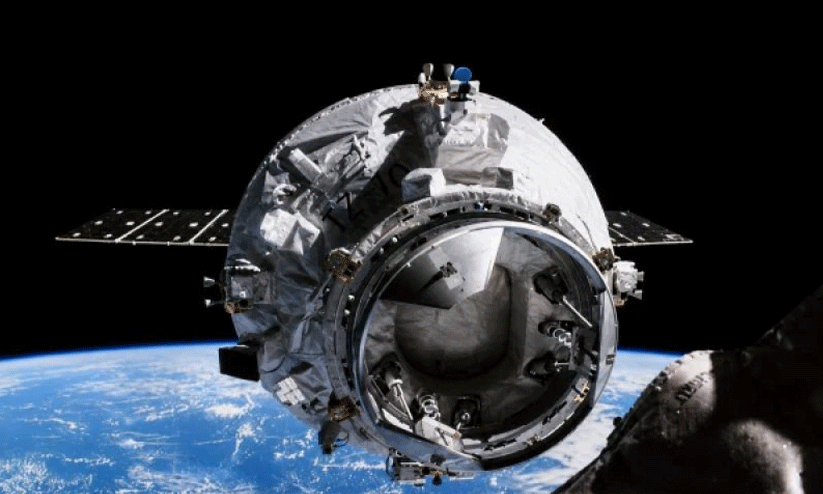

Beijing: China has launched an unprecedented scientific experiment aimed at answering one of the most critical questions surrounding humanity’s future beyond Earth: whether human reproduction can safely occur in space. In a world-first mission, Chinese scientists have sent artificial human embryo models to the country’s Tiangong space station to study how early human development is affected by the harsh conditions of space.
The project is being led by researchers from the Chinese Academy of Sciences and is expected to provide crucial insights for future human settlements on the Moon, Mars and other extraterrestrial destinations.
What is the mission?
The artificial embryo models were transported to the Tiangong space station aboard China’s Tianzhou-10 cargo spacecraft. The samples are not real human embryos but laboratory-created embryo-like structures developed from human stem cells.
Scientists aim to investigate how microgravity and intense cosmic radiation influence the earliest stages of human life. The findings could help determine whether normal embryonic development is possible in environments beyond Earth.
The experiment
Upon arrival at the space station, the cells were in a highly immature state. Using advanced automated systems and microfluidic chip technology, researchers allowed the embryo models to develop autonomously for five days.
The experiment recreated developmental stages comparable to those seen in human embryos between 14 and 21 days after conception. This is a crucial period during which the body’s basic structure begins to emerge, and the foundations of major organs start to form.
After the growth phase, the samples will be frozen and preserved for return to Earth, where they will undergo detailed analysis.
Parallel experiment on Earth
To accurately assess the impact of space conditions, scientists are simultaneously cultivating identical artificial embryo models in laboratories on Earth.
Comparing the development of space-grown and Earth-grown samples will allow researchers to identify changes caused specifically by microgravity and radiation exposure.
Why the experiment matters
The study addresses a major challenge facing future space colonisation. If humans are to establish permanent communities on the Moon or Mars, successful reproduction across generations will be essential.
Scientists believe gravity plays a key role in normal cell division and embryonic growth. The experiment seeks to determine whether the absence of gravity could cause developmental abnormalities or disrupt early biological processes.
The use of artificial embryo models also helps researchers avoid the ethical and legal challenges associated with experiments involving real human embryos, enabling large-scale investigation into one of space science’s most important unanswered questions.