



















NASA's Webb telescope captures detailed images of collision-shaped galaxy Centaurus A
text_fields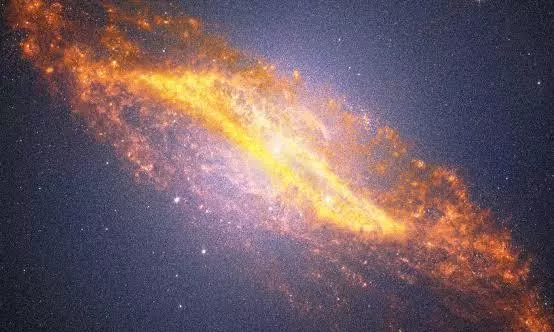

NASA has released new images of the galaxy Centaurus A captured by the James Webb Space Telescope, revealing its central region in unprecedented detail as the observatory marks its fourth year of science operations.
Located about 11 million light-years from Earth, Centaurus A is one of the closest active galaxies, making it a key target for studying how galaxies and supermassive black holes evolve together.
According to NASA, Webb's near- and mid-infrared instruments penetrated the thick dust surrounding the galaxy's core, exposing a dense population of individual stars that earlier visible-light observations could not detect.
At the centre of Centaurus A is a supermassive black hole that is actively consuming surrounding material. As it feeds, it emits powerful jets and vast amounts of energy that influence the galaxy's structure.
Scientists say the galaxy also bears evidence of a major collision with another galaxy that occurred about two billion years ago. The merger continues to shape its unusual appearance and ongoing star formation.
Earlier observations by NASA's Hubble Space Telescope were unable to reveal the galaxy's central region because dust obscured it in visible light. NASA's retired Spitzer Space Telescope detected large-scale infrared structures but could not resolve individual stars. Webb's observations now provide a much clearer view of the galaxy's inner regions.
Webb's mid-infrared images also reveal intricate dust formations, including a warped, parallelogram-shaped band across the galaxy's centre and wisps of material extending outward.
Shawn Domagal-Goldman, division director for Astrophysics at NASA Headquarters in Washington, said no single telescope can tell the complete story of the universe, adding that new observatories build on the discoveries made by earlier missions.