








China's Tianwen-2 captures first close-up image of Earth's rare 'minimoon'
text_fields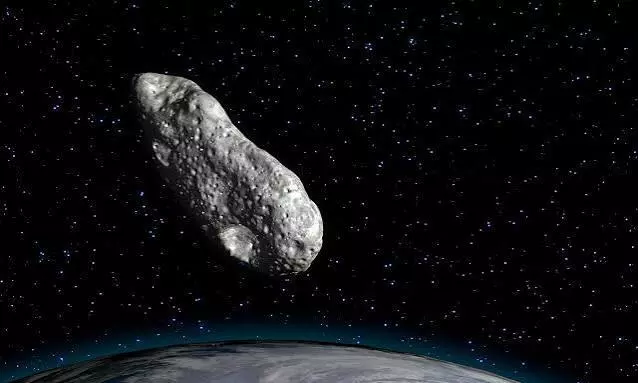

China's Tianwen-2 spacecraft has captured the first-ever close-up image of Kamoʻoalewa, a rare asteroid often referred to as Earth's "minimoon", after completing a 13-month journey of nearly one billion kilometres.
Launched on May 29, 2025, Tianwen-2 is the China National Space Administration's first mission to collect samples from an asteroid and return them to Earth.
The spacecraft first detected Kamoʻoalewa on June 6 and gradually approached the asteroid over the following weeks. By July 2, it had closed to within 20 kilometres, enabling it to capture detailed images of the object's irregular shape and rugged surface.
Despite its nickname, Kamoʻoalewa is not Earth's second moon. It is a quasi-satellite, a rare type of asteroid that orbits the Sun while remaining gravitationally linked to Earth. Its unique orbit keeps it close to the planet for extended periods, making it appear to circle Earth from Earth's perspective.
Scientists estimate Kamoʻoalewa is between 40 and 100 metres wide, making it one of the smallest asteroids ever visited by a spacecraft. Only seven quasi-satellites of Earth are currently known.
During the mission, Tianwen-2 will study the asteroid in detail, identify a suitable landing site and collect rock samples for return to Earth.
According to a paper published in Space Science Reviews, Kamoʻoalewa's Earth-like orbit makes it an ideal target for exploration because it requires relatively low energy to reach and remains at a stable distance for tracking and communication.
Scientists hope the returned samples will help determine the asteroid's origin. Earlier telescope observations have suggested Kamoʻoalewa may be a fragment of Earth's Moon that was ejected into space by an ancient impact. The mission is also expected to improve understanding of how quasi-satellites form, evolve, and remain near Earth over millions of years.