










Where Rahul Gandhi erred on Israel relations?
text_fields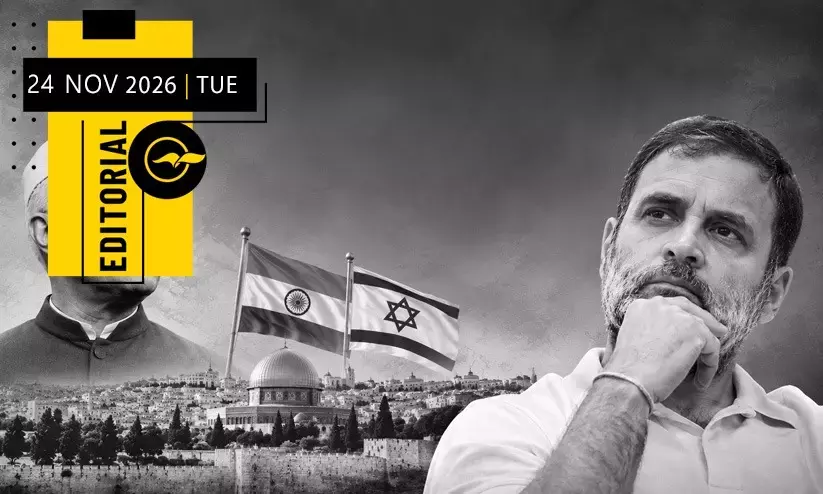

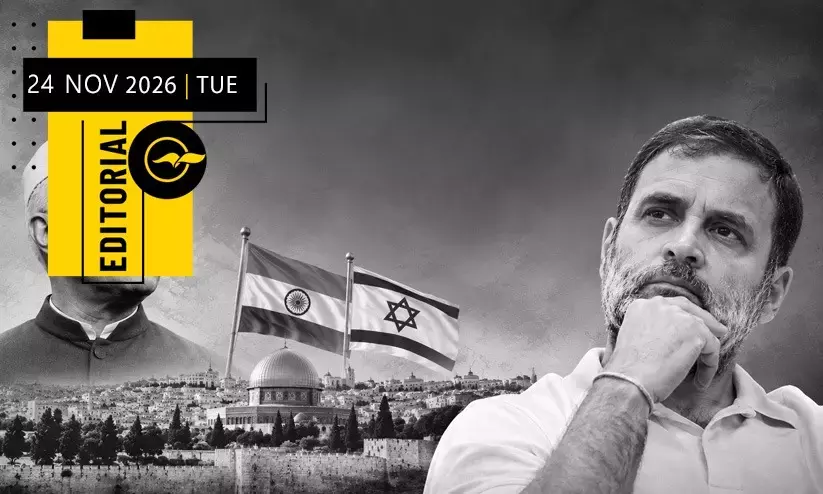
The remarks made by Leader of the Opposition Rahul Gandhi on India-Israel relations during a conversation with American political scientist Robert Pape at the University of Chicago in the US have triggered considerable surprise and resentment among anti-imperialist and democratic circles in India and abroad. Rahul was invited to an interview discussion on the topic ‘The Iran War and India's Global Relations’, organised by the Chicago Project on Security and Threats (CPOST) on November 18. Responding to a question about his position on the issue, raised in the context of Prime Minister Narendra Modi's relationship with Israel, Rahul said, " However, India must play its role on the global stage and demonstrate its influence. That should not be constrained by anyone". He explained that India's relationship with Israel and its procurement of arms from the country were driven by strategic considerations. "we have to buy the best weapons, and they happen to produce very good weapons", he said. As a large country with a population of 1.5 billion, India formulates its foreign policy based on what serves its own interests. Describing the October 7, 2023, Hamas attack as a horrific act that should never have happened, Rahul said killing innocent people was entirely wrong. He also condemned Israel's actions in Gaza, adding that neither of the two wrongs could be ignored.
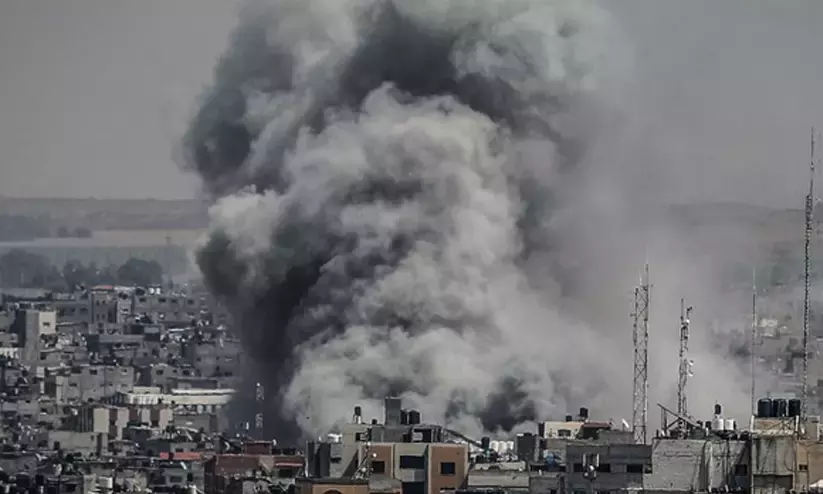
With the exception of those within the Zionist alliance, the rest of the world stands against Israel over the genocide in Gaza, which the world has described as disproportionate retaliation for the October 7 Hamas attack, and its expanding occupation. In an article published in The Indian Express last June, none less than Congress Parliamentary Party chairperson Sonia Gandhi made the party's position clear by opposing India's decision to distance itself from the global public opinion against the Israeli government's genocidal actions in Gaza and the displacement of hundreds of thousands of Palestinians from the occupied West Bank. Congress General Secretary Priyanka Gandhi had also launched a sharp criticism on X against India's silence over the ongoing genocide in Gaza. Given its political legacy, the Congress leadership can only adopt such a position towards Israel, which is committing atrocities against the Palestinian people.

When Israel emerged as an illegitimate offspring of imperialism, its formation was opposed by Mahatma Gandhi, the Father of the Nation, and Pandit Jawaharlal Nehru, India's first Prime Minister. Neither Gandhi nor Nehru could accept the creation of a Jewish theocratic state by taking away more than half of the land belonging to the Palestinians. What they and others had foreseen that this illegitimate creation would pave the way for acts of barbarity eventually came to pass. Following the 1948 war, Israel, whose population accounted for nearly one-third of the region's total, brought 77-78 per cent of Palestine's territory under its control. As a result, seven lakh Palestinians were driven out and rendered landless. Hundreds of villages were destroyed, leaving Palestinians as refugees without any documents or legal claims to their land. The Zionist state seized their land and turned it into Jewish settlements. The United Nations intervened several times, and numerous agreements were reached. However, disregarding them all, Israel continued expanding its empire by driving out the Arabs. Eventually, the international community proposed a two-state solution that would allow both communities to live in peace. Rejecting that proposal as well, Israel occupied not only Gaza, where Hamas had come to power through democratic means and was governing, but also the West Bank. Israel, which captured the Golan Heights in Syria in 1967, annexed the territory in 1981.
Israel's actions have never been limited to occupying Palestine. Since its establishment, it has pursued imperialist expansion through occupation. It is this colonisation and imperialist occupation that has turned independent democratic nations and societies against Israel. The Jewish state seeks to establish itself as an imperialist strongman by seizing the remaining territories in occupied Palestine and neighbouring areas, as is now evident in the West Bank, while killing and driving out the indigenous population. Resistance organisations ranging from the Palestine Liberation Organisation (PLO) to Hamas have carried out bloody retaliatory attacks against Israel in response to these actions. The October 7 attack was one such incident.
Thus, history did not begin on October 7, but it dates back to the very emergence of Israel. It was with this historical context in mind that India formulated its West Asia policy, beginning with the Nehru era. Therefore, whenever the Congress deviated from this position on the issue, strong protests were raised. Did Rahul make his new policy declaration without being aware of this history, or did he deliberately choose to disregard it? Rahul often criticises his political rival, Narendra Modi, for his double standards in championing freedom and democracy abroad while presiding over the authoritarian rule of racial hatred at home. Why, then, does he falter when explaining India's relationship with the Zionist empire, which is leading the global campaign of extermination driven by the same racial hatred? The surprise and resentment triggered by Rahul's remarks will subside only when these questions are adequately addressed.