


UAPA is not just a law
text_fields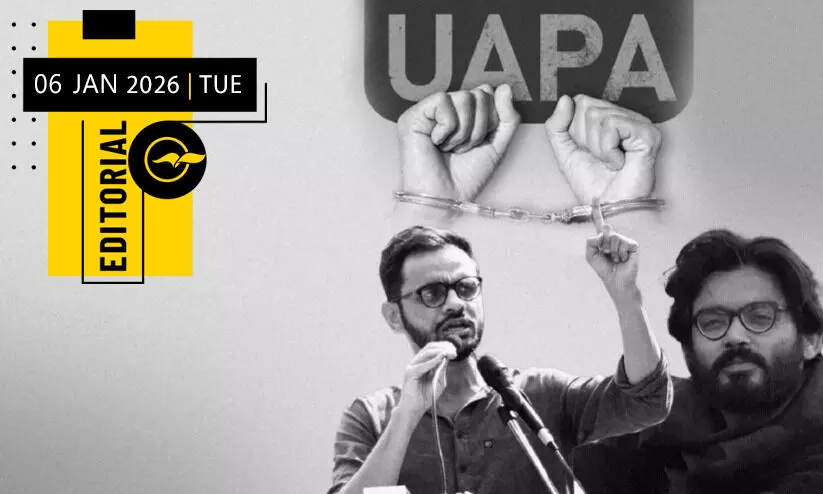

The Supreme Court on Monday rejected the bail pleas of student leaders Umar Khalid and Sharjeel Imam, who were arrested under the UAPA in connection with the communal violence that occurred in north-east Delhi during the protests against the Citizenship Amendment Act in 2020. The Court granted bail, subject to stringent conditions, to Gulfisha Fatima, Meeran Haider, Shifa-ur-Rahman, Mohammed Saleem Khan, and Shadab Ahmad, who have been in jail in the same case. Observing that all those in custody did not have an equal degree of involvement in the alleged offence, the apex court said that each individual’s role must be assessed separately. It also pointed out that, under Article 21 of the Constitution, the State may be able to justify the prolongation of pre-trial detention. However, the two-judge Bench comprising Justice Aravind Kumar and Justice N. V. Anjaria clarified in its order that the two accused who were denied bail cannot be granted the benefit of the trial being prolonged. It further reminded that those granted bail were not found eligible merely because of any relaxation in the allegations, and that the court has the authority to cancel bail if they fail to comply with any of the 12 stringent conditions imposed while granting bail.

During the protests in Delhi against the Citizenship Amendment Act (CAA) and the National Register of Citizens (NRC), communal riots broke out in Delhi on February 24, 2020. It was one of the most horrific communal attacks the capital had witnessed in recent decades. Over fifty people were killed, the majority of whom were Muslims. More than 700 people were injured, and over a thousand rendered homeless. There were losses amounting to crores in property, as well as business and employment losses. Police records noted that the riots did not occur spontaneously, but were backed by a well-planned conspiracy. In the 17,000-page chargesheet submitted on September 16, 2020, it was alleged that violent protests, civil disobedience, emotional speeches, WhatsApp messages, and financial transactions were all part of a terrorist conspiracy. With harsh sections of the Indian Penal Code and the UAPA invoked, 20 people were arrested and placed in indefinite pre-trial detention. The sections on conspiracy under the Indian Penal Code and the UAPA were applied together against the accused.
However, the accused argued that, in accordance with India’s rich democratic heritage, their actions were peaceful protests. They contended that there was no direct evidence of violence and that no weapons or other incriminating items were found. According to them, most of the case was based on pre-existing opposition, and the chargesheet was prepared by selecting witnesses and arbitrarily interpreting speeches and social media messages. The lawyers also submitted before the court circumstantial facts, such as Umar Khalid not being present at the riot sites, and Sharjeel Imam being in police custody before the riots began. For Gulfisha Fatima, repeated bail applications, submitted 90 times, were either postponed or rejected, highlighting the length of her detention before the court. However, when the detainees approached the Supreme Court after the Delhi High Court rejected their bail pleas, the court granted bail to five individuals while denying it to Umar Khalid and Sharjeel Imam. The court also noted that after one year, both accused could file bail applications again, meaning they would remain in pre-trial detention for another year.
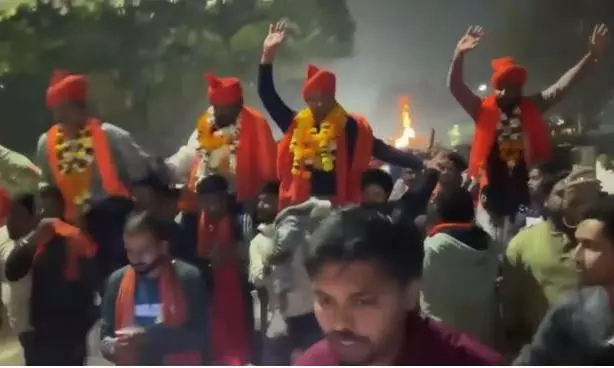
It is in context where the UAPA is currently in force, and under its provisions, numerous Muslim youths have been jailed, with many spending several years in detention before the courts eventually released them due to lack of evidence that the accused resort to seeking judicial intervention to ensure either a verdict without delaying the trial or the grant of reasonable bail in view of the uncertainty of pre-trial detention. However, the court highlighted that the UAPA is a provision where the normal principles of justice do not fully apply. The bail order on Monday conveys the message that objections regarding the indefinite prolongation of pre-trial detention do not apply to cases filed under the UAPA. The Supreme Court observed that when it comes to matters affecting national security, delay cannot be a matter to be used as a trump card to earn bail. The verdict also states that what mattered for the court while considering the bail petitions were factors such as the material circumstances presented by the prosecution to prove the alleged offences, issues related to the length of detention, and the possibilities under the UAPA provisions, and it was on this basis that the bench rejected the bail applications of Umar Khalid and Sharjeel Imam. The court did not go to the extent of examining the merits of the constitutionality of the charges brought against the detainees, but considered bail applications specifically under the provisions of UAPA, while also sending a message that the State’s urgent concerns in the matter deserve primary consideration.