









Israel may get a new head, but will its fate change?
text_fields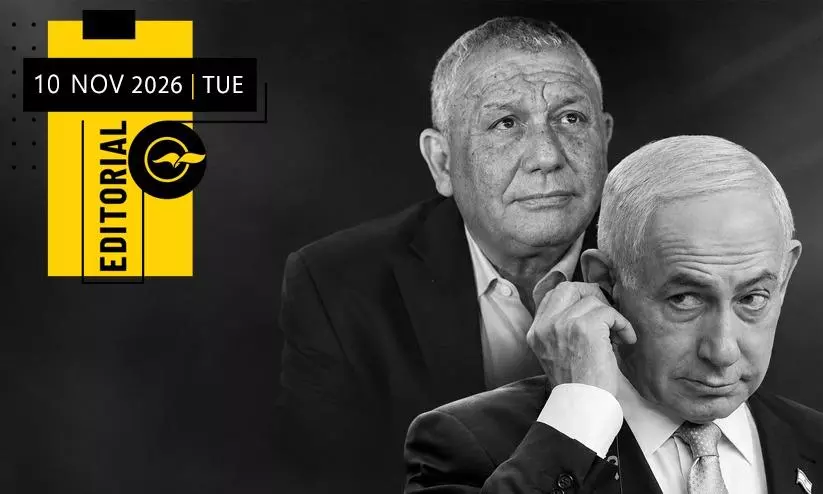

With Israeli President Isaac Herzog having invited Gadi Eisenkot, leader of the opposition Yashar Party, to form a new government, the world is watching closely to see whether this will bring an end to Benjamin Netanyahu's blood-soaked rule. While 67 members, including 19 Arab representatives, supported Eisenkot for the post of prime minister, Netanyahu received the backing of only 46 members. Herzog has given Eisenkot, a former military chief, four weeks to form a government. If he fails to do so within that period, the deadline will be extended by another two weeks. If he fails again, the second- and third-ranked candidates are to be given similar opportunities. If no one succeeds in forming a government, the country will go for another election, as per the electoral system followed in Israel. Having faced a similar situation in the past, Eisenkot cannot afford to be reassured merely by receiving the invitation to form a government. The strength of the coalition led by Netanyahu's Likud party has declined by eight seats, from 64 in 2022 to 56. Even so, Likud remains the single largest party, having secured six more seats than Eisenkot's Yashar Party, which won 21 seats. Having accepted the President's invitation, Eisenkot has already begun efforts to expand his coalition. Beyond their opposition to Netanyahu, however, the parties in his alliance have little in common. On major issues such as national security, religious discrimination and the occupation of Palestine, the coalition partners are on opposing sides.
Even with the inclusion of Yair Golan's centre-left Democrats, former Prime Minister Naftali Bennett's centre-right Together Party and Avigdor Lieberman's right-wing Yisrael Beiteinu, the alliance can muster only 48 seats. This is where the Arab parties become crucial. Among them, the Ra'am Party, as well as the Joint List, an alliance comprising the Arab-Jewish Hadash party and the parties Ta'al, which advocates Palestinian rights in Israel, and Balad, have also declared their support for Eisenkot. It is only with their support that the strength of the opposition alliance reaches 67 seats. Meanwhile, the victorious alliance has decided not to bring any of the Arab parties anywhere near its coalition. Although Golan's Democrat party are inclined to including Ra'am, Avigdor Lieberman is opposed to even a minority government that depends on Arab support. He believes that the numbers required to form a government can be secured without involving the Arab parties, simply by bringing in ultra-Orthodox factions such as United Torah Judaism and Shas. These parties, which together hold seven seats, have so far not declared their support for any candidate for prime minister. Eisenkot must overcome this political uncertainty if he is to bring an end to the Netanyahu era. He has already begun efforts to secure the support of as many lawmakers as possible. Excludin Netanyahu, he is also welcoming members of the Likud Party into his camp.

The opposition alliance, which is now seeking to form a government, wants an administration made up exclusively of Jewish parties, without the support of Arab factions. By promoting such a position, it is also seeking to attract Netanyahu's critics within the Likud Party. At the same time, Eisenkot has openly expressed his willingness to form a united front by including organisations representing people of Arab origin. It is this move that has prompted other far-right members of the alliance to intensify efforts to win over anti-Arab and ultra-conservative parties as a pressure tactic. Naftali Bennett, who is currently part of the alliance, had earlier formed a government with the support of the Ra'am Party and even included it in his Cabinet. However, Bennett now appears to have concluded that it is better to tread cautiously, keeping in mind the predominantly right-wing leanings of the electorate. Netanyahu has yet to come to terms with his defeat and subsequent removal from power. The victory of Arab parties, which secured 19 seats, has particularly infuriated the racist leader. Since the election results were announced, Netanyahu and his allies have been engaged in an intensive campaign alleging irregularities in Arab voting. However, investigative agencies themselves have found these allegations to be false. Three Arab Bedouin activists were arrested on election day on allegations that they had attempted to influence voters in favour of the Ra'am Party, but the charges could not be substantiated. Allegations of foreign funding against the Joint List also failed to gain traction.
The political manoeuvres surrounding the formation of a new government make it clear that neither Netanyahu nor even those who defeated him seem to remember that the strong protests within Israel against the genocide in Gaza had also translated into votes against him, contributing to the eventual election outcome. This also indicates that even if Netanyahu is replaced by Eisenkot, that need not translate into any major change in the country's political direction. There may be a change of leadership in Israel, but that alone does not necessarily mean a change in the fate of its people or the rest of the world.