














Somnath temple: Let history rest, Modiji
text_fields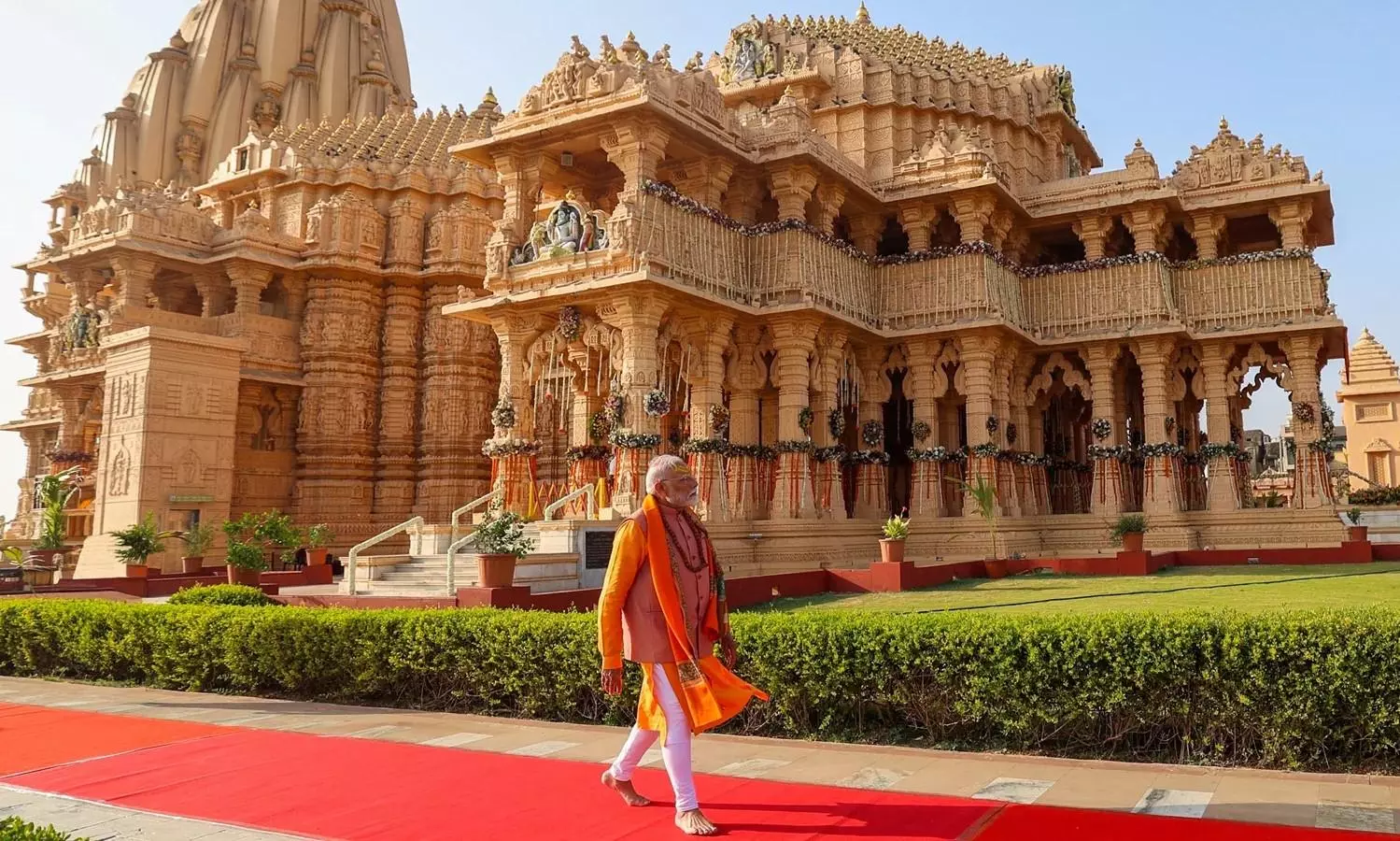
I had visited Gujarat several times over the years, but Somnath had eluded me. It was one of those places that had lived in the imagination long before it appeared on any itinerary. I had grown up reading about the Somnath temple—its antiquity, its destruction, its resurrection—and I wanted to see it not as a symbol endlessly invoked in political rhetoric, but as a living place of faith. When an opportunity finally arose in 2024, I decided it was time.
I persuaded a friend—an avowed atheist whose disbelief has never interfered with his wife’s fondness for temple visits—and my own wife to organise a short trip. Faith, scepticism and companionship travelled together, as they often do in India, without friction or argument. That, in itself, felt reassuring.
At Somnath, photography inside the temple complex is prohibited except for accredited professionals, so my camera stayed in the car. I managed a few pictures from outside, but perhaps it was just as well. Some experiences are meant to be absorbed rather than documented.
What struck me immediately was the sheer number of people. The turnout was massive, the devotion palpable. The evening aarti was grand, almost theatrical, and the sound-and-light show that followed transformed the temple structure into a giant screen, narrating its story through images, sound and spectacle. It was a seamless fusion of technology and piety—modern tools employed to heighten an ancient emotion. One could admire the scale without necessarily surrendering to the messaging.
The reconstruction of the temple is impressive by any measure. It stands today as a marker of India’s civilisational self-confidence and architectural renewal, a declaration that the country has both the resources and the will to restore what it values. In short, I was glad I had finally visited Somnath. My wife and our friends felt the same. It was a satisfying, even uplifting experience.
It was against this backdrop that I read, with more than a little shock, an article by Prime Minister Narendra Modi—who also happens to head the Somnath Trust—published across newspapers today to mark what he described as the 1,000th anniversary of the temple’s destruction by Mahmud of Ghazni.
The Prime Minister revisited, in graphic detail, Ghazni’s raids: the killings, the desecration, the destruction of idols, the repeated attacks—fifteen in all, according to some historical accounts. He cited books that vividly describe the horrors inflicted.
I found myself wondering: was this really necessary? Was this the moment, and was this the voice, to exhume a trauma a millennium old? If the Prime Minister found these historical works so compelling, I wish he had mentioned their titles. Readers might then have engaged with history themselves rather than receive it filtered through the prism of political authority.
The timing was impossible to miss. December 6 had just passed—the anniversary of the demolition of the Babri Masjid in 1992. We are often told that this is a date we should not revisit, that the country has “moved on". Apparently, some memories are best forgotten, while others—no matter how old—must be periodically revived.
It is perfectly acceptable, we are told, for the Prime Minister to recall events from 1,000 years ago. But remembering an event from just three decades ago is deemed disruptive. This selective amnesia should trouble anyone who values consistency, let alone justice.
If the Prime Minister wished to write about Somnath, there were other, far more constructive occasions to do so. The anniversary of its rebuilding—the golden jubilee, diamond jubilee, or eventually its centenary—would have been fitting moments to reflect on renewal rather than ruin. By that logic, we might also commemorate the day the British first landed in Surat in Gujarat, from where they expanded their presence and eventually ruled the subcontinent. History offers no shortage of invasions; wisdom lies in choosing what to emphasise.
More troubling was Modi’s use of the article to reopen old political battles. He credited Sardar Vallabhbhai Patel with initiating the reconstruction of the temple—true enough—but accused Jawaharlal Nehru of opposing it, implying obstruction or hostility. This is, at best, a distortion.
What Nehru objected to was not the rebuilding of a temple, but the involvement of the state in a religious enterprise. For him, secularism was not a slogan but a governing principle. He believed the government of independent India should not be seen as sponsoring or endorsing any religion. That position was principled, consistent, and constitutional.
It did not diminish his respect for Patel—nor Patel’s respect for him. Nehru’s letters and speeches speak warmly of Patel’s integrity, administrative acumen and commitment to national unity. Patel, for his part, was born a Congressman, lived as a Congressman, and died a Congressman. He also has the distinction of banning the RSS in the aftermath of Mahatma Gandhi’s assassination—an inconvenient fact for today’s political narratives.
Despite their differences, Nehru and Patel never allowed disagreements to corrode mutual respect. Contrast this with today. One shudders to imagine what might happen to a senior minister who openly defied the Prime Minister. Would he be reasoned with—or removed within minutes?
Mr Modi also points out that President Rajendra Prasad attended the inauguration of the Somnath temple, even though Nehru disapproved. The Prime Minister presents this as evidence of Nehru’s intolerance. But did Nehru take any action against the President? He did not. He respected the autonomy of constitutional offices.
Compare that with recent history. A former Vice-President was asked to resign within hours for allegedly displeasing the government. When the Ram temple in Ayodhya was consecrated, neither the President nor the Vice-President was invited. Had they been, protocol would have required the Prime Minister to play second fiddle, since both rank higher in the order of precedence.
The same exclusion was evident during the inauguration of the new Parliament building. Once again, the highest constitutional authorities were conspicuously absent. So much for respect for institutions.
And yet, Modi finds fault with Nehru for doing nothing more than articulating a principled belief—that a secular state should not interfere in religious affairs. Nehru himself rarely visited temples, churches or mosques. Modi visits all of them, frequently and publicly. That is his personal choice. But personal religiosity should not be confused with constitutional propriety.
History, too, has a sense of irony. Mahmud of Ghazni returned to his kingdom and died of illness at the age of 58. For nearly 750 years thereafter, nothing much happened to Ghazni. It was the British who eventually attacked it, installing a ruler of their choosing.
Today, Afghanistan—of which Ghazni is a part—is hardly a civilisational adversary. Despite being ruled by the Taliban, it has, at crucial moments, expressed solidarity with India, including during Operation Sindoor, when other global powers hesitated. History does not follow neat communal lines.
Sanatana Dharma, it is worth remembering, is far older than 1,000 years. Somnath is but one of the twelve Jyotirlingas. For Hindus, the sanctity of a temple does not lie in the grandeur of its structure, but in the faith it inspires. Stones can be broken and rebuilt; belief endures without spectacle.
I left Somnath content, enriched by the experience. I only wish the Prime Minister had waited for the anniversary of rebuilding, not destruction, to write his article. A nation secure in itself does not need to nurse ancient wounds. It can afford to remember—but it must also know when to let history rest.