

















Saudi, regional partners view Israel’s one-sided Rafah opening as aimed at displacing Gazans
text_fields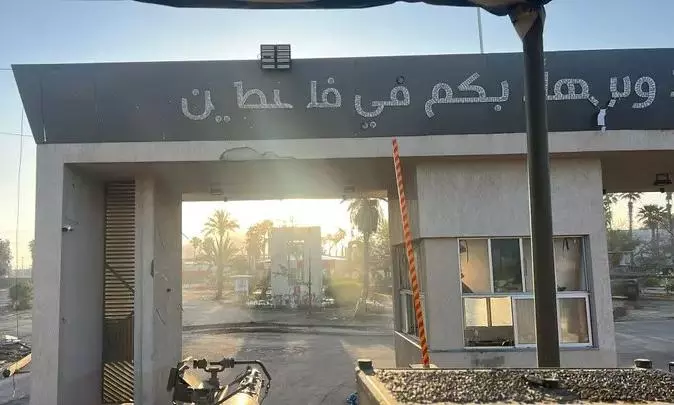

Slamming Israel’s statement of opening the Rafah crossing in only one direction, the foreign ministers of Saudi Arabia, Egypt, Jordan, the UAE, Indonesia, Pakistan, Turkiye and Qatar jointly stated that the announcement was nothing but an attempt to force Palestinians out of Gaza and urged Israel to adhere to the Trump plan, which called for the crossing to function in both directions while guaranteeing freedom of movement without coercion.
The ministers, speaking through a joint communication, conveyed deep concern that restricting passage to a single direction would create conditions conducive to the displacement of Palestinians into Egypt, and they underlined that any such outcome would be unacceptable as it would undermine the right of Palestinians to remain on their land, according to the Saudi Press Agency.
They stressed that the regional approach must prioritise stability by creating an environment in which Palestinians can stay within their homeland and participate in long-term recovery and reconstruction efforts aimed at addressing the humanitarian crisis in Gaza.
They noted that the Trump plan, referenced as the framework requiring full respect, envisioned free and secure movement through the Rafah crossing, and they argued that only adherence to this approach would prevent demographic pressure and ensure that Palestinians are neither coerced nor compelled to leave.
The statement further emphasised the urgent need for a sustained ceasefire and an immediate end to civilian suffering, and it called for unobstructed humanitarian access that would enable early recovery and reconstruction across the enclave.
The ministers added that such conditions were essential for allowing the Palestinian Authority to resume its responsibilities and re-establish administrative stability in Gaza.
The eight countries reaffirmed their willingness to work closely with the United States and with international partners to ensure the full implementation of UN Security Council Resolution 2803 and other relevant resolutions, and they maintained that a just and lasting peace must be rooted in international law and the two-state solution.
The statement also urged the need for a durable settlement based on the establishment of an independent Palestinian state along the 1967 borders with East Jerusalem as its capital, and it signalled that regional coordination would continue until this outcome was achieved.