

















Kerala HC pulls up Waqf Board over composition, imposes curbs
text_fields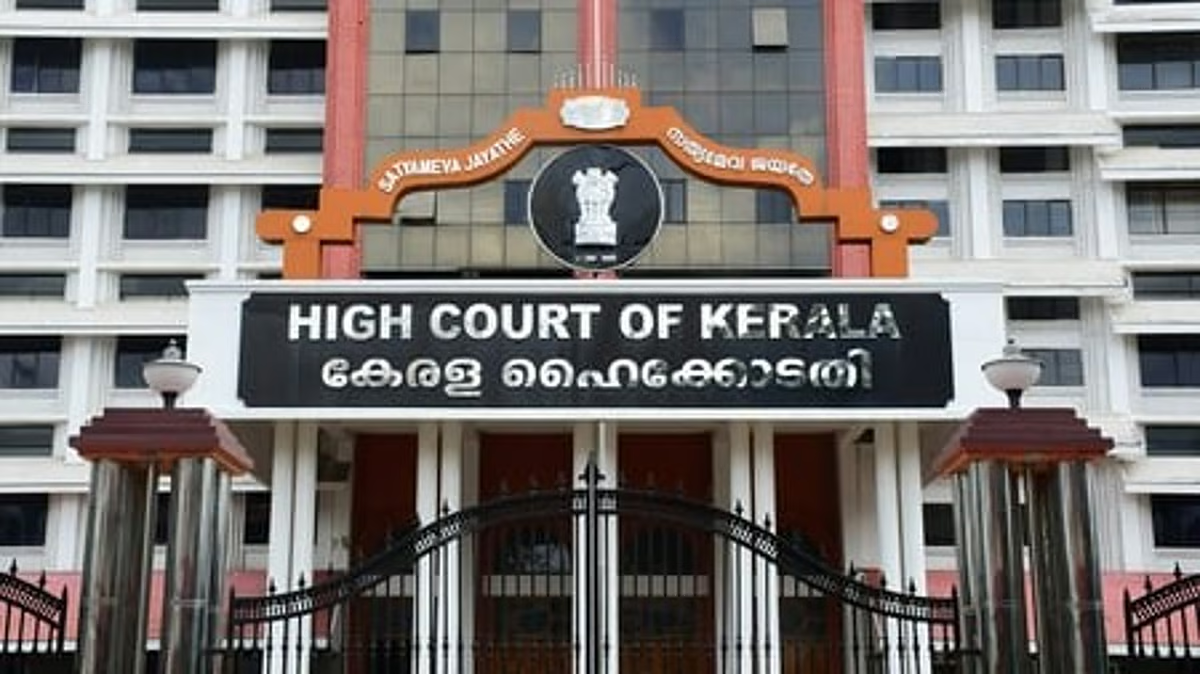

Thiruvananthapuram: The Kerala High Court on Wednesday issued an interim order restraining the state Waqf Board from taking major decisions after observing that its present constitution appears to be inconsistent with the provisions of the Waqf Act.
A Division Bench comprising Chief Justice Soumen Sen and Justice V.M. Syam Kumar held that the Board was prima facie not constituted in accordance with Section 14 of the Unified Waqf Management, Empowerment, Efficiency and Development (UMEED) Act, 1995, as amended, as it lacks two mandatory non-Muslim members and a Shia representative.
Pending a final decision, the court directed the Waqf Board not to take any major policy decisions, incur capital expenditure or make important administrative decisions without prior permission from the court.
The Bench also ordered that the Board would function under the supervision of the Joint Secretary of the state government department dealing with Waqf affairs until further orders.
The interim order was passed while hearing four public interest litigations challenging the legality of the Board's constitution.
During the hearing, the Kerala government admitted that there were shortcomings in the composition of the Board.
Advocate General Jaju Babu informed the court that the government had filed an affidavit acknowledging the deficiencies.
When the Bench sought clarification, the Advocate General indicated that the state government was willing to reconstitute the Board in accordance with the law.
Appearing for the Waqf Board, Senior Advocate T. Krishnanunni admitted that two non-Muslim members had not been nominated.
He submitted that the appointments were delayed due to issues relating to the matter before the Supreme Court.
However, the Additional Solicitor General and the petitioners informed the court that no such cases were currently pending before the apex court.
The petitions argue that the Waqf Board has not been constituted in accordance with the amended Waqf Act.
One of the petitions, filed by the Assembly of Christian Trust Services (ACTS), also challenges the inclusion of the disputed Munambam land in the Centre's UMEED portal, contending that it adversely affects Hindu and Christian residents and that only the muttawali is authorised to upload details of Waqf properties.
Another petition, filed by BJP leader Shone George, seeks the immediate appointment of two non-Muslim members and a Shia representative, and a declaration that the current Board is functioning in violation of the amended law.
The High Court has posted the matter for further hearing next week.
With IANS inputs