


















Toxic smog envelopes Delhi as air quality worsens
text_fields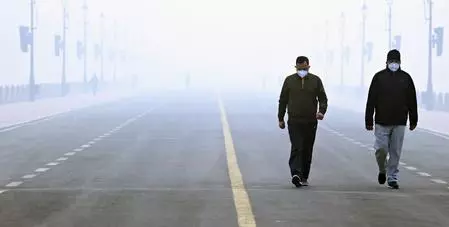

New Delhi: The national capital's air pollution, which had already reached the "severe" category, got worse on Sunday as a thick layer of toxic smog covered the city, raising the air quality to dangerous levels and impairing visibility in a number of places.
The Central Pollution Control Board (CPCB) released data showing that Delhi's average Air Quality Index (AQI) increased from 431 to 461 at 7 a.m. on Sunday. The concerning numbers highlighted the nation's capital's worsening air quality problem.
All 40 air quality monitoring stations across Delhi reported readings in the ‘severe’ category, with several locations nearing the maximum measurable limit. Rohini emerged as one of the worst-affected areas, recording an AQI of 499, followed closely by Bawana at 498. Vivek Vihar reported 495, while Ashok Vihar and Wazirpur registered AQI levels of 493 each. Narela recorded 492, and Anand Vihar stood at 491, IANS reported.
Other parts of the city also remained heavily polluted. ITO recorded an AQI of 485, Mundaka 486, Punjabi Bagh 478, Nehru Nagar 476, and both Chandni Chowk and Okhla registered readings of 470, reflecting widespread and persistent pollution across the capital city.
The air quality crisis was not confined to Delhi alone, as several cities in the National Capital Region (NCR) also reported dangerously high pollution levels.
Noida recorded an AQI of 470, placing it firmly in the ‘severe’ category, while Ghaziabad followed closely with a hazardous AQI of 460. Gurugram’s air quality remained in the ‘very poor’ category at 348, while Faridabad recorded a comparatively lower but still concerning AQI of 220, classified as ‘poor’.
The worsening pollution was evident from early morning, with dense smog mixed with fog engulfing the region. In several areas, visibility dropped to near zero, severely disrupting early-morning movement.
The reduced visibility prompted authorities to activate low-visibility procedures at the Indira Gandhi International Airport. While flight operations continued, officials said pilots were operating under precautionary protocols due to fluctuating and poor visibility conditions.
Issuing a warning, the India Meteorological Department (IMD) had said that visibility at the IGI Airport would likely fall to as low as 100 metres during the early morning hours on Sunday due to dense fog, before improving to around 800 metres later in the day as shallow fog conditions prevailed.
The combination of stagnant weather conditions, dense fog and persistent emissions continues to worsen air quality, raising serious health concerns for residents across Delhi and the NCR.