












SC clarifies order, permits Friday prayers near Kamal Maula Mosque
text_fields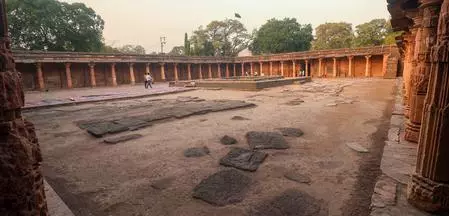
Photo: IANS

New Delhi: The Supreme Court on Thursday clarified its earlier interim order in the Bhojshala–Kamal Maula dispute, directing that members of the Muslim community be allowed to offer Friday prayers between 1 pm and 3 pm on a designated plot of dargah land adjoining the disputed Bhojshala complex.
A Bench comprising Chief Justice of India Surya Kant and Justices Joymalya Bagchi and V. Mohan heard an application filed by the Muslim side seeking an alternate site for Friday prayers after the Madhya Pradesh High Court held that the disputed Bhojshala premises is a temple. The High Court's ruling has been challenged before the apex court.
Earlier, the Supreme Court had declined to restore the previous arrangement allowing prayers at the disputed site and had instead directed the Madhya Pradesh government to identify an alternative location near the Bhojshala complex for Friday namaz, Maktoob Media reported.
Appearing for the Muslim applicants, Senior Advocate Huzefa Ahmadi argued that the site identified by the district administration was not sufficiently close to the disputed premises. He submitted that the allotted land was about 1.3 km away by road and around 900 metres away in a straight line, and pointed out that several waqf properties adjoining the Bhojshala complex were available for use.
Ahmadi also informed the court that the mutawalli had filed affidavits expressing no objection to Friday prayers being held on the adjoining waqf land. Referring to a site plan, he identified four possible locations near the disputed premises and argued that any of them would satisfy the court's earlier direction to provide an alternative site in the vicinity of Bhojshala.
He opposed the Collector's refusal to allot adjoining land on the ground of possible law and order issues, contending that constitutional rights could not be curtailed because of threats of disruption. He also argued that Friday prayers had earlier been held in an adjacent area outside the disputed complex without any difficulty.
During the hearing, Justice Joymalya Bagchi asked which of the identified locations had previously been used for prayers under court orders. Ahmadi responded that the applicants were willing to accept any site the court considered appropriate.
The Bench observed that the plot marked in yellow on the site plan appeared suitable as it had an independent access road. Ahmadi said the applicants had no objection to using that location.
Appearing for the Madhya Pradesh government, Additional Solicitor General K.M. Nataraj submitted that the State's primary concern was maintaining law and order and that it was not taking a position on the competing ownership claims. He added that the government was willing to consider any other acceptable site, including private land, if required.
Justice Bagchi observed that while maintaining law and order was the State's constitutional responsibility, the religious rights of the parties also had to be protected.
Clarifying its earlier order, the Bench directed that the Muslim community be allowed to offer Friday prayers between 1 pm and 3 pm on the specified dargah land adjoining the Bhojshala complex. The court noted that the site had an independent access road and was adjacent to the disputed premises, making it a suitable location for prayers.
The court further clarified that its order would not prevent the parties from mutually agreeing on any other suitable location and directed the State authorities to make the necessary arrangements to facilitate Friday prayers.
The dispute concerns the Bhojshala–Kamal Maula complex in Dhar, which is claimed by Hindus as a temple dedicated to Goddess Saraswati and by Muslims as the Kamal Maula Mosque. On May 15, the Madhya Pradesh High Court accepted the Hindu claim based on an Archaeological Survey of India (ASI) report, set aside the 2003 ASI arrangement permitting shared religious use of the site, and held that namaz could no longer be offered at the disputed premises. The High Court, however, permitted the Muslim community to approach the State government for an alternative site to construct a mosque.