














PIL against anti-Muslim bias FIRs over ‘I Love Muhammad’ no public interest: Delhi HC dismisses
text_fields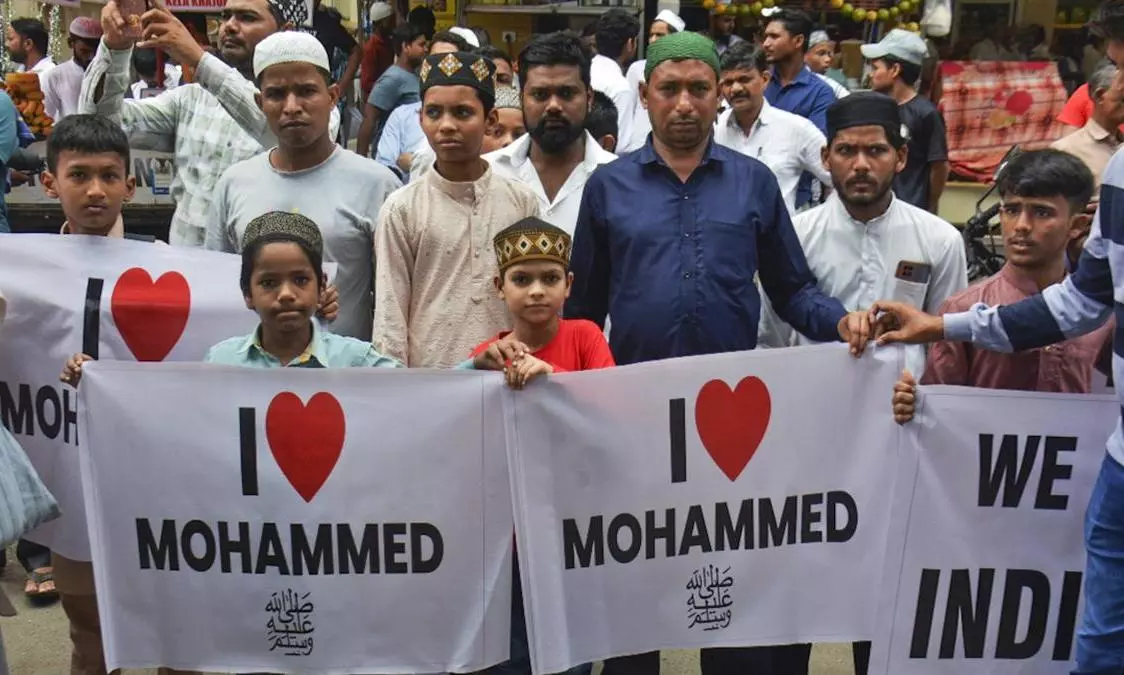

The FIRs filed against Muslims over the “I Love Muhammad” posters in Uttar Pradesh and Uttarakhand during Milad-un-Nabi were challenged through a PIL in the Delhi High Court, which alleged that the cases arose from anti-Muslim bias and sought to criminalise peaceful expression; however, the court dismissed the plea, citing its lack of jurisdiction over FIRs registered in other states, besides noting that it lacked public interest.
A division bench comprising Chief Justice D.K. Upadhyaya and Justice Tushar Rao Gedela ruled that the petitioner, Shujaat Ali, had no sufficient cause to invoke public interest jurisdiction, clarifying that individuals directly affected by the FIRs were free to seek appropriate legal remedies.
The bench thus declined to entertain the plea, stating that the Delhi High Court could not intervene in matters falling under the jurisdiction of other states’ police and judicial systems.
The petition had alleged that the Uttar Pradesh and Uttarakhand police acted with communal prejudice while registering the FIRs, claiming that Muslims who displayed “I Love Muhammad” posters during Eid-e-Milad-un-Nabi were criminalised for peaceful religious expression.
It argued that the cases reflected targeted action against members of one community while ignoring the acts of vandalism and aggression carried out by Hindutva groups that had instigated the unrest.
The controversy began on 4 September 2025 in Kanpur, Uttar Pradesh, when local Muslims in Zafar Wali Gali, Syed Nagar, Rawatpur, installed a simple signboard bearing the phrase “I Love Mohammed” during a Barawafat procession as a mark of reverence for the Prophet.
Soon after, members of Hindutva organisations vandalised the signboard and raised anti-Muslim slogans, following which the Kanpur police filed an FIR against 25 Muslims on charges of promoting enmity and disturbing public order, while no immediate action was taken against those who vandalised the poster.
According to the Association for Protection of Civil Rights (APCR), at least twenty-one FIRs were registered, and more than 1,300 Muslims were initially booked, including 38 arrests. By 7 October, the numbers had sharply increased to 4,505 Muslims booked and 265 arrested, among whom 89 were from Bareilly alone, as reported in the organisation’s fact-finding document.
The report also detailed accounts of night raids on Muslim homes, arbitrary detentions, including minors without family notification, the denial of FIR copies to lawyers, and the demolition of houses where “I Love Muhammad” posters had been displayed.
Advocates such as Mohammad Imran Khan described the police action as unjust and symptomatic of a growing impunity for hostility towards Muslim religious expressions, contending that the criminalisation of peaceful displays of devotion undermined constitutional protections for faith and expression.
Despite these concerns, the Delhi High Court concluded that the matter did not warrant its intervention, as it fell outside its territorial jurisdiction and did not qualify as an issue of public interest under the court’s purview.