









New released anthology stands in solidarity with jailed activist Umar Khalid
text_fields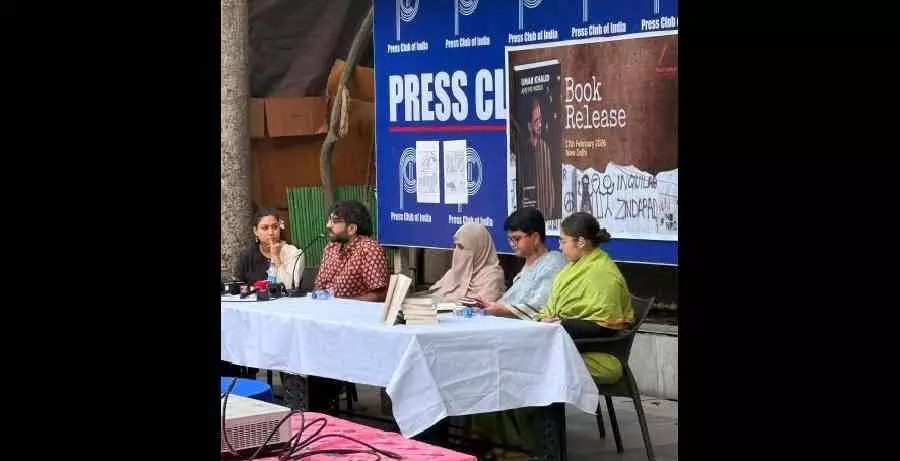
Photo: The Telegraph

The book Umar Khalid and His World: An Anthology, released on Tuesday at the Press Club of India in New Delhi, was presented by its organisers as an effort to broaden solidarity around Umar Khalid and to honour those who have been imprisoned or targeted for raising their voices against injustice.
In the acknowledgements, the anthology characterises the current political climate as “the theatre of the absurd, when lies masquerade as history, when genocide passes as ‘self-defence’, and legality becomes only a tool to subvert justice.”
The editors observe that more than five years have passed since peaceful protesters against the Citizenship Amendment Act were jailed, and they criticise what they describe as the shrinking space for democratic dialogue and the conflation of dissent with terrorism.
The book accuses those in power of responding to criticism with what it calls a sweeping witch-hunt, pointing to cases linked to Bhima Koregaon and the Delhi riots. It alleges that misinformation campaigns and media trials were used to incarcerate individuals portrayed as defenders of constitutional values.
Co-edited by Anirban Bhattacharya, Banojyotsna Lahiri and Shuddhabrata Sengupta, and published by Three Essays Collective, the introduction frames the anthology as an act of friendship and solidarity, inviting readers to extend a wider circle of support to Khalid, who has been in custody since September 13, 2020.
The editors portray him not only as a political prisoner and historian, but also as someone who has everyday relationships and interests, from friendships to cricket and late-night conversations, Maktoob Media reported.
The editors note that despite spending years in prison, with only two brief and conditional bail periods to attend family weddings, Khalid has remained resilient in spirit even while confined physically. Sengupta is quoted as saying that Khalid and others like him were targeted because they directly challenged what he described as a populist, xenophobic and majoritarian form of authoritarian politics.
Speaking to Maktoob, Lahiri said the phase of injustice had stretched over several years and involved sustained political targeting. She explained that Khalid’s writings from prison prompted the editors to go beyond compiling his work alone and to include reflections by others to capture both his voice and the broader political context surrounding his incarceration.
At the book launch, the editors stood against a graffiti backdrop of 3 protest figures, including a woman in a burqa raising the slogan “Inquilab Zindabad.” Bhattacharya said the image had once appeared on the walls of Shaheen Bagh and Jamia during the anti-CAA movement but was later erased, which he described as an attempt to wipe out symbols of dissent. He added that the anthology aimed to serve both as a record of a grim period and as evidence that people had responded with defiance, compassion and solidarity.
Legal scholar Gautam Bhatia, who contributed an analysis of trial court orders, said the reasoning in successive orders had steadily deteriorated. He argued that the Unlawful Activities (Prevention) Act had increasingly been used to enable prolonged detention of those the State disfavoured, while courts had facilitated this by repeatedly denying bail.
He maintained that there was no direct call for violence by any of the accused and no concrete evidence linking them to rioting, adding that the protests they called for were peaceful demonstrations against the CAA and NRC. He also pointed out that a majority of those killed in the violence were Muslims, and said there was no clear evidentiary link tying the accused to those deaths.
Bhatia further argued that the prosecution’s broad reliance on a conspiracy narrative effectively turned the absence of direct evidence into grounds for continued incarceration. He described recent bail orders under the UAPA as deeply troubling, warning that they allowed sweeping and implausible claims in charge sheets to be reproduced in court orders, with objections deferred to trials likely to stretch on for years, leaving the accused in jail for prolonged periods.
Khalid’s mother, Sabiha Khanum, said her son continued to be a source of strength for her family despite the Supreme Court declining to grant him bail. She expressed gratitude for the solidarity he continued to receive, adding that such support gave the family courage in their ongoing struggle.
The anthology brings together contributions from a wide range of public figures, including historians Romila Thapar and Ramachandra Guha, writer-academic Apoorvanand, activist Harsh Mander, political leaders Jignesh Mevani and Yogendra Yadav, actor Prakash Raj, and journalist Ravish Kumar, alongside Khalid’s prison writings and reflections from family members, fellow detainees and civil society voices.
Journalist and editor Apeksha Priyadarshini reflected on her visits to Tihar jail, saying that meeting Khalid had prompted deep reflection on what she saw as deeper social decay. She said their conversations about prison life offered insights into wider social realities beyond the jail.
Writer Sabika Abbas Naqvi, in her contribution, reflects on what she describes as the burden of performing nationalism as a Muslim in India.