




John Brittas calls for constitutional review of Gujarat anti-radicalisation SOP
text_fields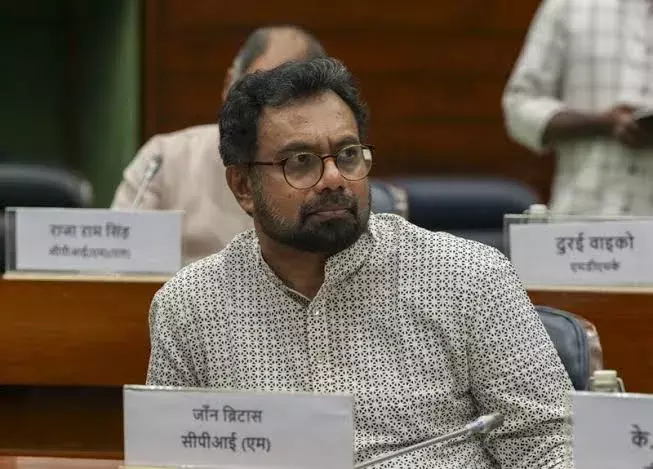

New Delhi: CPI(M) Rajya Sabha MP John Brittas has written to Gujarat Chief Minister Bhupendra Patel, urging the state government to keep its reported Anti-Radicalisation Standard Operating Procedure (SOP) and the establishment of Anti-Radicalisation Cells (ARCs) in abeyance pending a comprehensive constitutional review.
In his letter, Brittas expressed concern over reports that the Gujarat State Intelligence Bureau had issued an SOP directing the establishment of ARCs across the state.
"If the reported SOP is indeed in force, its implementation should be kept in abeyance pending a comprehensive review of all provisions that may directly or indirectly permit profiling or surveillance based on religion, religious practices, attire, language, appearance or other constitutionally protected characteristics," he wrote.
Brittas also called for the SOP to be examined by an independent panel comprising constitutional experts, eminent jurists and experienced policing professionals to ensure that it fully complies with the Constitution and established principles of criminal jurisprudence.
While acknowledging the state's constitutional responsibility to prevent terrorism and violent extremism, the Rajya Sabha MP stressed that counter-radicalisation measures must remain firmly rooted in the Constitution, the rule of law and the protection of fundamental rights.

Describing the reported provisions as "deeply disquieting", Brittas cited alleged behavioural indicators listed in the SOP, including growing a beard, wearing a niqab, using Arabic expressions in conversation, reacting strongly to incidents affecting Muslims globally, leaving education or employment for religious reasons, meeting religious leaders frequently, and visiting mosques and madrasas identified as "sensitive".
"If these reports accurately reflect the contents of the purported SOP, they risk treating ordinary manifestations of religious identity and constitutionally protected conduct as grounds for police suspicion," he said.
The CPI(M) leader also objected to reports that the SOP envisages extensive surveillance of social media platforms, messaging applications, encrypted communication services, community networks and religious institutions.
He argued that while intelligence agencies may legitimately monitor unlawful activities based on credible information, surveillance or profiling based primarily on religion, language, attire or religious observance would raise "profound constitutional concerns".
Drawing a distinction between lawful conduct and activities linked to terrorism, Brittas said the possession or dissemination of extremist material, procurement of explosive precursors, or demonstrable links with terrorist organisations could legitimately attract scrutiny. However, he said religious, cultural and personal practices protected by the Constitution should not be conflated with criminal conduct.
"The two cannot be conflated," Brittas wrote, warning that such an approach could violate constitutional guarantees under Articles 14, 19, 21, 25 and 26.
Referring to constitutional jurisprudence, he said equality before the law requires citizens to be assessed on the basis of credible evidence of unlawful conduct rather than faith, cultural identity, attire, language or appearance.
"Any institutional framework that creates an impression of profiling a particular community would be inconsistent with the constitutional promise of equal protection of laws," he said, adding that such policies could erode public trust in law enforcement and discourage cooperation in tackling genuine extremism.
Brittas urged the Gujarat government to withdraw or suitably amend any provisions found to be inconsistent with constitutional safeguards so that counter-radicalisation measures remain evidence-based, focused on demonstrable unlawful or violent conduct, and backed by adequate safeguards against arbitrary or discriminatory application.
The letter follows reports that the Gujarat State Intelligence Bureau issued a confidential SOP directing every district to establish Anti-Radicalisation Cells.
According to the reports, the Jamnagar Police has already operationalised the mechanism by appointing PSI M.V. Modhwadia to head the district unit under the supervision of SP Dr Ravi Mohan Saini.

The move offers the first public indication of the implementation of Gujarat's anti-radicalisation framework. The reported SOP instructs police to monitor social media platforms, encrypted messaging services, religious organisations and individuals displaying a range of behavioural and digital indicators associated with "radicalisation".
A confidential Gujarat Police document reportedly revealed the creation of Anti-Radicalisation Cells across all district and commissionerate police units, directing officers to monitor social media activity, encrypted messaging platforms, VPN usage and behavioural changes among individuals considered vulnerable to radicalisation.
The reported implementation of the framework has drawn criticism from civil rights organisations and human rights activists, who have demanded an immediate rollback of the Anti-Radicalisation Cells.