


















ISRO successfully tests air-drop for Gaganyaan’s parachute system
text_fields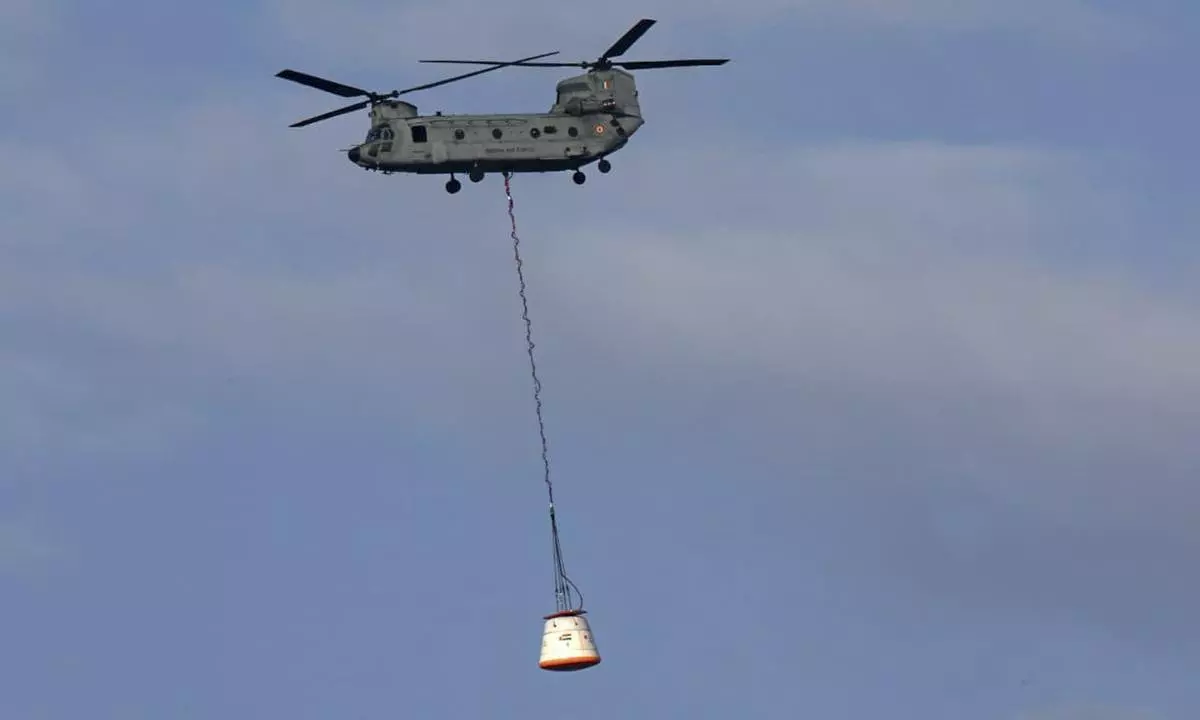
PTI photo.

Bengaluru: ISRO successfully carried out the first Integrated Air Drop Test (IADT-01) on Sunday to validate the parachute-based deceleration system for the upcoming Gaganyaan mission, PTI reported.
An ISRO official told PTI that the end-to-end demonstration was conducted near Sriharikota in Andhra Pradesh.
The exercise was jointly executed by ISRO, the Indian Air Force, Defence Research and Development Organisation (DRDO), the Indian Navy and the Indian Coast Guard.
The Gaganyaan project aims to demonstrate India's capability to send humans into space and safely return them to Earth. Planned as the country's first human spaceflight programme, it will also involve precursor unmanned missions to test systems critical for crew safety.
The parachute-based deceleration mechanism is a key component to ensure the safe recovery of the crew module during re-entry and landing.
In other news, students of the Indian Institute of Technology Bombay (IIT Bombay) successfully mapped the Moon’s surface chemistry using data from Chandrayaan-2, the institute announced on Saturday. This effort was part of the Indian Space Research Organisation’s (ISRO) U R Rao Satellite Centre (URSC) challenge conducted during the Inter-IIT Tech Meet, IIT Bombay said in a statement.
The Moon, lacking an atmosphere, is constantly exposed to strong X-ray radiation from the Sun. When these X-rays strike the lunar surface, the elements there emit unique light, a natural form of X-ray fluorescence, which allows scientists to identify the Moon’s composition. Chandrayaan-2’s Large Area Soft X-ray Spectrometer (CLASS) uses this effect to scan the lunar surface from 100 km above, collecting data in wide strips during each orbit. Over the years, CLASS has mapped nearly the entire Moon, generating a rich dataset on ISRO’s Pradhan portal, much of which had remained unexplored scientifically until now.