
















India’s diplomat challenges Pakistan over terrorism at UN
text_fields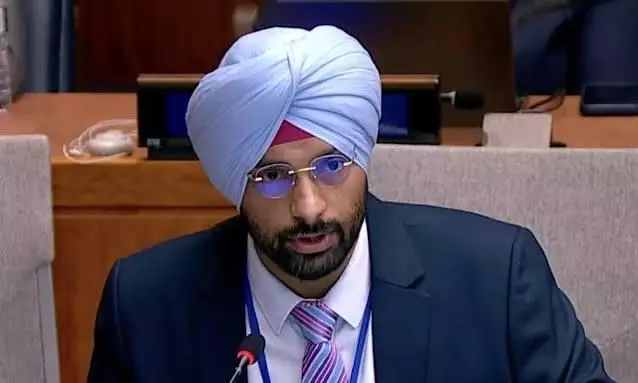

Indian diplomat Anmol Sher Singh Bedi challenged Pakistan over terrorism and nuclear proliferation at the 81st session of the United Nations General Assembly’s First Committee, defending India’s right to self-defence.
Exercising India’s right of reply, Bedi defended New Delhi’s military action following the Pahalgam terror attack, which killed 26 civilians.
"As you're aware, India's actions in May last year followed a grave provocation. India acted in self-defense after Pahalgam terror attack, where twenty-six civilians were killed. These actions were measured, targeted, and designed to be non-escalatory," he told the committee.
Bedi also questioned Pakistan’s position on the Indus Waters Treaty, emphasising the importance of mutual trust.
"The Indus Water Treaty, when it was signed, rested on good faith and goodwill. A state cannot undermine those foundations of trust and cooperation and at the same time insist that the privileges flowing from the relationship remain untouched," he said.
On nuclear proliferation, Bedi referred to the AQ Khan network and United Nations Security Council Resolution 1540, which requires states to prevent non-state actors from acquiring weapons of mass destruction.
"We urge all states and all responsible suppliers to exercise the highest degree of vigilance, not because of India, but for their own security," he said.
Bedi warned against using nuclear weapons to deter responses to terrorist attacks. "Nuclear weapons must not be treated as routine instruments of statecraft," he said.
He also stressed that states must be held responsible for violence carried out through non-state actors. "The use of force by states under the garb of non-state actors does not erase the state's responsibility," Bedi said.
Reiterating India’s position on Jammu and Kashmir, he said New Delhi would not bow to nuclear blackmail. "India does not seek conflict," he said. "However, if there is no accountability for reckless actions, then peace merely becomes a pause between crises."