













Key facts about India’s journey to becoming a Republic
text_fields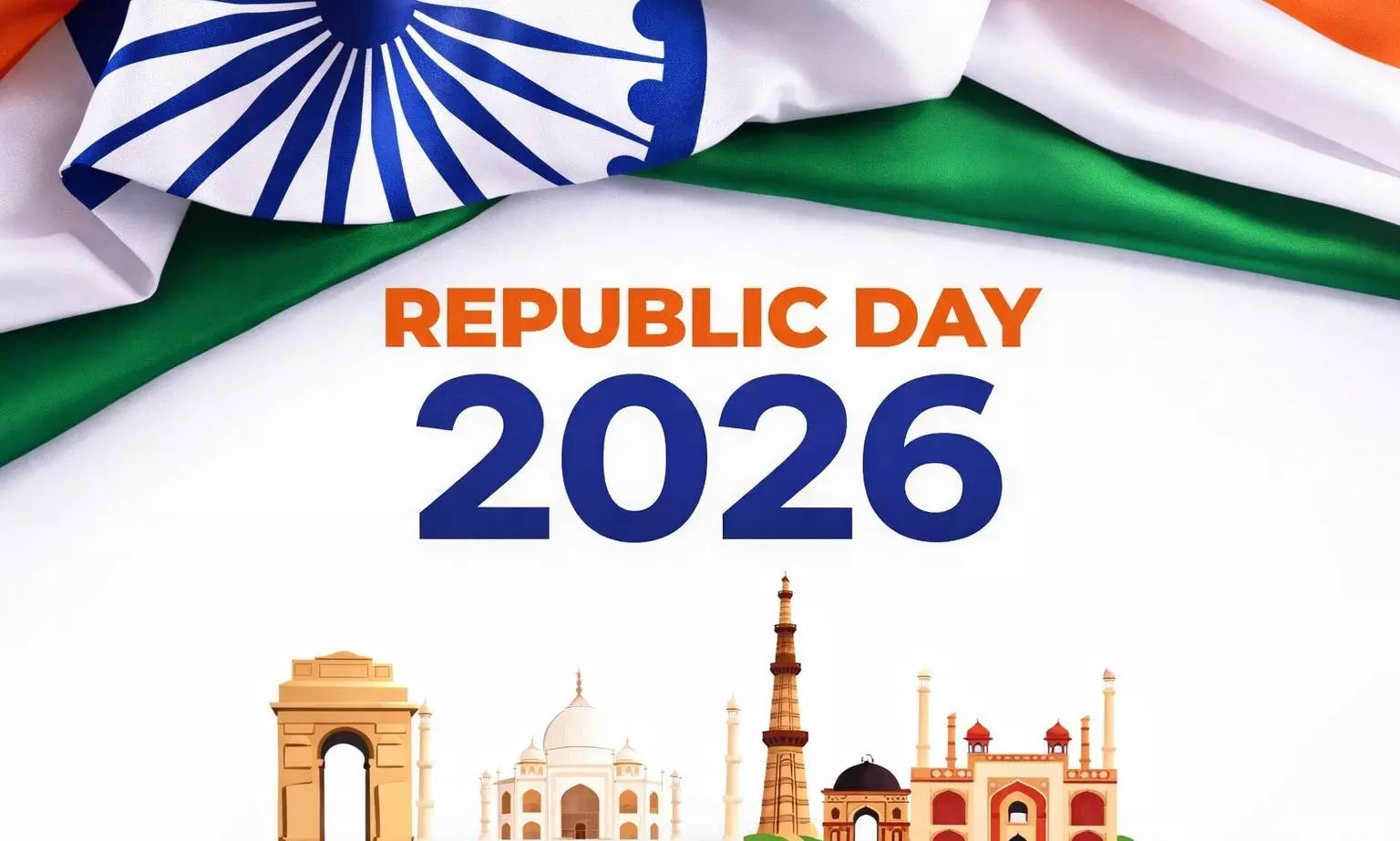

When the country celebrates the 77th Republic Day on Monday, 26 January 2026, it would be worthwhile to brush up on some interesting facts about its background and the celebrations.
• India attained Independence on 15 August 1947.
• The Constitution of India was adopted on 26 January 1950.
• While Independence Day marks freedom from alien rule, Republic Day symbolises the character and nature of governance in India, with people’s participation at its core.
• Prior to India becoming a Republic, the country was governed under the provisions of the Government of India Act, 1935, enacted by the British Government.
• Why 26 January? On this date in 1930, the Indian National Congress declared Purna Swaraj, or complete independence. This meant a pledge to continue the struggle until the country won freedom. Since the declaration was made on 26 January, the date was chosen to commemorate the event when the Constitution was ready.
• A 21-gun salute and the unfurling of the Indian National Flag by Dr Rajendra Prasad heralded the historic birth of the Indian Republic on Republic Day in 1950.
• In the interregnum between 15 August 1947 and 26 January 1950, the country remained a constitutional monarchy, in the sense that it was governed by a Governor-General and the British monarch was the head of state. What made India a Republic was the adoption of the Constitution.
• It took around 2 years, 11 months and 18 days to draft the Indian Constitution. The task was entrusted to a Drafting Committee led by Dr B. R. Ambedkar.
• The President replaced the British monarch as the head of state. A Republic, by definition, is a country headed by an elected representative of the people. Dr Rajendra Prasad was sworn in as India’s first President on 26 January 1950.
• India’s original Constitution was a handwritten document, calligraphed in both English and Hindi — the English version by Prem Behari Narain Raizada and the Hindi version by Vasant Krishnan Vaidya.
The pages were decorated with exquisite artwork. Even today, these handwritten versions are carefully preserved in the Library of Parliament.
• Although Dr B. R. Ambedkar is rightly known as the chief architect of the Indian Constitution, nearly 300 members of the Constituent Assembly were involved in its creation.
• On 24 January 1950, 284 members signed the Constitution.
• The first Republic Day parade in 1950 was not held at Rajpath, as is currently the case. Between 1950 and 1954, it was held at Irwin Stadium, now known as the National Stadium, in Delhi.
• In 1955, Rajpath — then called Kingsway — became the permanent venue for the parade.
• Although Republic Day is observed on 26 January, the celebrations continue for three days. The ceremony known as Beating Retreat, marking the conclusion of the celebrations, is held on 29 January, when military bands perform patriotic tunes and flags are lowered.
• A chief guest from another country is invited to attend the Republic Day ceremony, a tradition that highlights India’s diplomatic relations and international standing. President Sukarno was the first foreign guest at the 1950 celebration.
• Awards such as the Kirti Chakra, Padma Awards and the Bharat Ratna are announced on the eve of Republic Day.
• India’s literacy rate was 16.6 per cent in 1951; by 2026, it stands at 74 per cent.
• It may also be recalled that India’s first general election, conducted under the Constitution, was held between October 1951 and February 1952.