












Historians criticise NCPUL-backed Urdu translation glorifying Savarkar
text_fields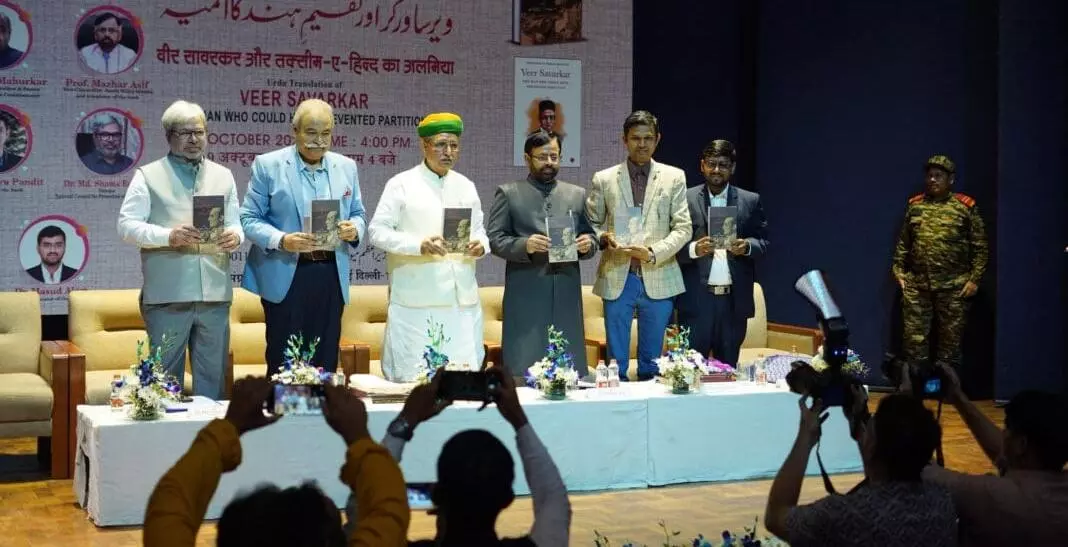

The Narendra Modi government has faced criticism after the National Council for the Promotion of Urdu Language (NCPUL), an autonomous body under the Ministry of Education, released an Urdu translation of a book that praises Hindutva leader Vinayak Damodar Savarkar. Critics have accused the government of using official institutions to promote ideologues associated with Hindutva.
The translated book, titled Veer Savarkar aur Takseem Hind ka Alamiya, is based on Veer Savarkar: The Man Who Could Have Prevented Partition by Uday Mahurkar and Chirayu Pandit, which was first published in 2021.
The Urdu edition was unveiled on Thursday during an event held at the Prime Minister’s Museum in New Delhi.
During the launch, Law Minister Arjun Ram Meghwal reportedly referred to Savarkar as a visionary who cared deeply about national unity and integrity. He suggested that, in his view, India’s partition might have been avoided if Savarkar’s ideas and strategies had been adopted at the time.
According to the official release, Meghwal stated that if Savarkar’s ideas and strategies had been put into practice, India might have avoided fragmentation, Maktoob Media reported.
At the same event, author and former Central Information Commissioner Uday Mahurkar, who contributed to the book, remarked that the publication offers what he called the first “accurate and balanced” portrayal of Savarkar in independent India’s history. He pointed out that, in his view, long-standing misconceptions shaped by political narratives were now being challenged through historical evidence.
Professor Mazhar Asif, Vice Chancellor of Jamia Millia Islamia and one of the book’s translators, described the work as a comprehensive examination of Savarkar’s character and his thoughts on national progress and unity. Asif, who has previously drawn criticism for attending programmes linked to BJP and RSS-affiliated groups, has faced questions about whether such associations could affect Jamia’s institutional independence.
He said the book’s strength lies in its effort to re-evaluate existing perceptions of Savarkar through reasoned analysis and factual evidence—knowledge he believes is essential for every Indian citizen.
The Urdu translation of the book was undertaken by Professor Mazhar Asif, Vice-Chancellor of Jamia Millia Islamia.
According to the event’s media release, the authors stated that their work aimed to provide “truthful and unbiased information” while countering what they described as misconceptions propagated by certain political ideologies.
However, several historians and former officials of the NCPUL have raised objections, arguing that the narrative being promoted about Savarkar contradicts established historical records.
Professor Nadeem Rezavi, secretary of the Indian History Congress and a faculty member at Aligarh Muslim University, reportedly said that he found the development “shocking.” He pointed out that Savarkar was one of the earliest proponents of the two-nation theory—well before the Muslim League adopted it in 1940.
Citing Savarkar’s 1937 address to the Hindu Mahasabha, Rezavi noted that Savarkar had described Hindus and Muslims as two distinct nations, rhetoric that he said deepened communal divisions and helped create the conditions that ultimately led to Partition.
Rezavi also observed that under Savarkar’s leadership, the Hindu Mahasabha had entered coalition governments with the Muslim League in Sindh and Bengal during the Quit India Movement. He added that Savarkar had even supported Travancore’s attempt to remain independent in 1947 as a counter to what he viewed as a secular Indian state.
According to Rezavi, Savarkar’s ideology promoted Hindu dominance rather than coexistence, and it was this divisive worldview, he argued, that helped pave the way for Partition.
A former NCPUL official also questioned the council’s move, describing it as a departure from its foundational purpose. The official remarked that the council was established to promote the Urdu language and literature, not to publish works glorifying politically contentious figures.