



















Govt spends public funds on RSS chief’s security, denies RTI disclosure on expenditure
text_fields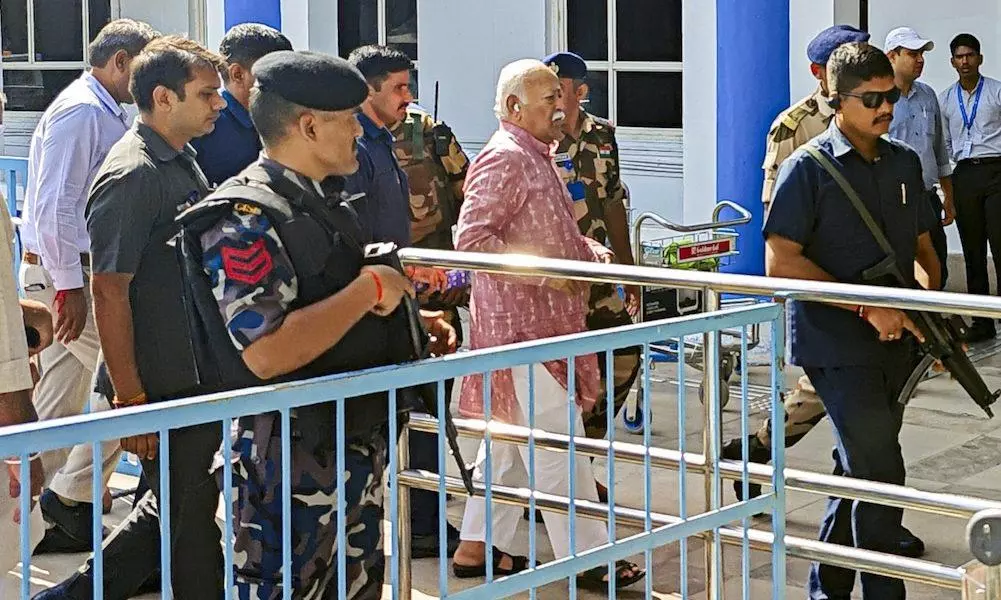

The Right to Information Act, which requires government institutions to be transparent about their operations and spending, yielded no response from either the Home Ministry or the CISF when applications were filed seeking disclosure of the expenditure on the security of RSS Chief Mohan Bhagwat; the Home Ministry stated that revealing such information might potentially pose a security risk or lead to privacy concerns.
The responses, issued separately by the Ministry of Home Affairs and the CISF under the provisions of the RTI Act, have reignited contentious debates surrounding secrecy, public accountability and the expanding architecture of State-sponsored VIP security, particularly in instances involving individuals who do not occupy any constitutional or governmental office.
Bhagwat, who serves as the Sarsanghchalak of the Rashtriya Swayamsevak Sangh, a non-governmental ideological organisation, nevertheless continues to enjoy an elaborate ‘Z-Plus’ security cover funded through public resources, according to The Wire.
The RTI application, filed on April 16, 2026, sought detailed disclosures concerning the cumulative expenditure incurred on Bhagwat’s security since 2015, including annual allocations, logistical expenses, deployment-related costs, vehicle and communication infrastructure expenditure, weaponry procurement, travel arrangements and the additional financial implications arising from subsequent upgrades in his security cover, The Wire report suggested.
A parallel application addressed to the CISF sought clarity regarding the number of personnel assigned to Bhagwat, their rank structure, the existence of any specialised unit designated for his protection and the total number of VVIPs presently under CISF security cover.
However, in its reply dated May 7, 2026, the VIP Security Unit of the Home Ministry refused disclosure by invoking Sections 8(1)(g) and 8(1)(j) of the RTI Act, provisions which respectively permit withholding of information on grounds of security risks and unwarranted invasion of privacy.
The ministry neither furnished expenditure figures nor revealed the precise contours of the security protocol or the Standard Operating Procedures governing the arrangement.
The CISF, in a separate response dated April 24, 2026, adopted a more categorical posture of denial, asserting that under Section 24 of the RTI Act and the Second Schedule attached to it, the force remains exempt from routine disclosure obligations except in matters involving corruption or human rights violations.