


Delhi-NCR reels under smog as AQI touches 380; restrictions tightened under revised GRAP
text_fields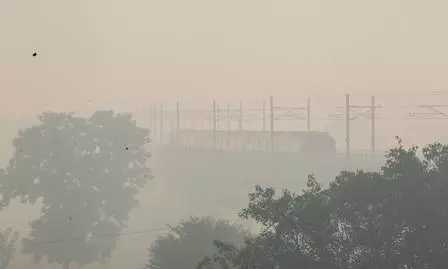

New Delhi: Delhi-NCR continued to struggle with alarming pollution levels on Sunday as the overall Air Quality Index (AQI) clocked 380, placing the region in the ‘very poor’ category, according to Central Pollution Control Board data.
By 7:15 a.m., several monitoring stations across the capital recorded severe pollution levels. Jahangirpuri topped the list with an AQI of 438, while Bawana reported 431, Anand Vihar 427, and Ashok Vihar 421, all falling within the ‘severe’ range.
In neighbouring areas of the National Capital Region, Noida’s air quality stood close to the severe mark at 396, while Greater Noida recorded 380, both under the ‘very poor’ category. Ghaziabad, however, crossed the threshold with an AQI of 426, categorised as ‘severe’. The situation in Gurugram and Faridabad was slightly better, registering indices of 286 and 228 respectively, indicating pollution levels in the ‘poor’ range.
Taking note of the worsening air quality, the Commission for Air Quality Management (CAQM) for NCR and adjoining areas announced a revision to the Graded Response Action Plan (GRAP) on Saturday.
As per the revised framework, measures that were earlier reserved only for the ‘severe’ category under Stage IV of GRAP will now come into force at Stage III. These include uninterrupted power supply to minimise diesel generator usage, additional deployment of personnel at traffic congestion points, issuance of pollution-related alerts on all media platforms, and expansion of CNG and electric public transport fleets with higher service frequency. The plan also introduces differential fares to encourage travel during off-peak hours.
Additionally, several actions earlier placed under Stage III for ‘very poor’ conditions have now been shifted to Stage II. Among these are the implementation of staggered working hours for government offices across Delhi, Gurugram, Faridabad, Ghaziabad, and Gautam Buddh Nagar. The Centre is also considering similar staggered timing arrangements for its offices located in the region.
Meanwhile, restrictions that were previously applicable only under Stage IV, such as allowing government, municipal, and private offices to operate with 50 per cent staff presence and directing the rest to work from home, will now take effect at Stage III itself.
In line with the CAQM’s new directions, the Delhi government has advised private offices to follow the 50 per cent on-site workforce limit, allowing the remaining employees to work remotely. This precautionary measure aims to reduce vehicular movement and curb emissions as the capital continues to face deteriorating air quality conditions.
(Inputs from IANS)