

















Civil society, religious groups, slam Rajasthan anti-conversion law as draconian
text_fields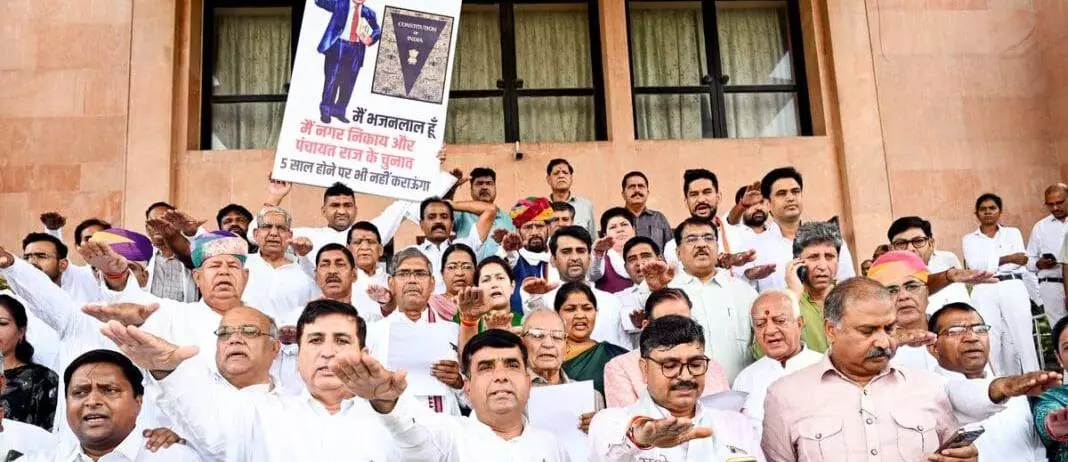

A group of civil society groups, religious organisations, and political parties issued a joint statement on Thursday opposing the anti-conversion law recently passed by the Rajasthan Assembly. They described the legislation as draconian, accusing it of fueling majoritarian hostility and instilling fear among minority communities in the state.
According to the signatories, the Bill represents an attempt by the ruling BJP to promote the ideology of the Sangh, targeting minorities and fostering an atmosphere of intimidation.
The statement, endorsed by groups such as the People’s Union for Civil Liberties, Association for Protection of Civil Rights, the Rajasthan Buddhist Mahasangh, the Jaipur Christian Fellowship, the All India Democratic Women’s Association, the Rajasthan Samagra Seva Sangh, the Movement Against Repression, Rajasthan, the Youth Buddhist Society of India, Jamaat-e-Islami, Rajasthan, the Jamiat Ulama-e-Hind, the Rajasthan Nagrik Manch, the Dalit Muslim Ekta Manch, and the Social Democratic Party of India, also cautioned that the law could create a two-class system of governance that treats citizens unequally, Maktoob Media reported.
Several organisations expressed concern that the Rajasthan Religious Conversion Bill, 2025 was broader, harsher, and more intrusive compared to similar laws already enacted in 11 other states, including the amended Uttar Pradesh legislation of 2024.
According to them, the Bill’s provisions were unconstitutional in multiple aspects, ranging from the way conversion was defined to the mechanisms proposed and the severity of punishments.
They also drew attention to the rise in violence, pointing out that more than nine attacks against the Christian community had taken place since the Bill was introduced in the Assembly on September 3 and passed on September 9, which they said reflected growing lawlessness in the state.
As part of their plan, the groups intended to meet with the governor to request that he withhold approval and instead send the Bill to the President under Article 200.
They recalled that similar approaches had worked in the past, when Governors in 2006 and 2008 were persuaded to forward such Bills to the President rather than give assent.
The organisations indicated that they would reach out to different communities, including minority groups, through public debates aimed at exposing what they saw as the Bill’s legal weaknesses and constitutional violations. Their campaign plans included rallies, public gatherings, online outreach, as well as signature and postcard drives.
They also intended to approach the Supreme Court once the law took effect, aligning with other pending challenges against similar state legislation.
According to them, the Bill imposed disproportionately harsh punishments, with offences classified as cognisable and non-bailable, making it legally untenable.
The groups pointed to a series of attacks since the Bill’s introduction, citing incidents in Alwar on September 3 — the day it was tabled — along with two attacks each in Hanumangarh, Dungarpur, and Kotputli-Behror districts, and two in Sanganer constituency in Jaipur, the stronghold of Chief Minister Bhajan Lal Sharma.
They further underlined concerns about the Bill’s mandatory disclosure requirements, arguing that the provision allowing anyone to report a suspected violation could easily be misused, enabling police inquiries that compromise privacy and curtail individuals’ freedom to choose their religion.
The organisations further pointed out that, similar to provisions in some other states, the Rajasthan law explicitly exempts the Sangh Parivar’s Ghar Wapsi programmes. Citing Section 3(4), they explained that anyone returning to their “original” or “ancestral” religion is not considered to have converted, meaning no prior permission is required in such cases. In contrast, all other conversions demand approval from the Collector at least three months in advance.
They argued that the law fails to define what constitutes an “original” or “ancestral” religion, thereby implying Hinduism as the default and elevating it above all other faiths, including Buddhism, Jainism, Sikhism, Islam, and Christianity. This, they maintained, runs counter to constitutional guarantees under Articles 14, 19, 21, and 25.
According to them, the legislation also carries the risk of criminalising ordinary acts of worship and placing constraints on religious freedom under Article 25, effectively subordinating minority communities and denying followers of non-Hindu faiths the full exercise of their fundamental rights.
The organisations argued that the penalties prescribed under the new law went beyond what could be considered reasonable or proportionate and would likely fail judicial scrutiny.
The Rajasthan Prohibition of Unlawful Conversion of Religion Bill, 2025 — also referred to as the Anti-Conversion Bill or Freedom of Religion Bill — was first introduced in February 2025 and cleared by the state assembly on September 9, making Rajasthan the 12th state in the country with such legislation.
This was the state government’s third attempt at bringing in an anti-conversion law, with earlier efforts in 2006 and 2008 blocked after the President declined to give assent following resistance from the Congress, minority groups, and human rights organisations.
The latest version introduces far stricter punishments than its predecessors. It prescribes sentences ranging from seven years to life imprisonment, along with heavy fines, with harsher penalties in cases involving minors, women, Scheduled Castes or Scheduled Tribes, persons with disabilities, or instances of mass conversion. Repeat offenders face a minimum of 20 years’ imprisonment and fines of up to ₹50 lakh. The law also provides that accepting foreign or illegal funds for conversion activities can lead to 10–20 years in prison and fines starting at ₹20 lakh.