














BRICS Summit: Central, Delhi govt offices to remain closed on Sept 11
text_fields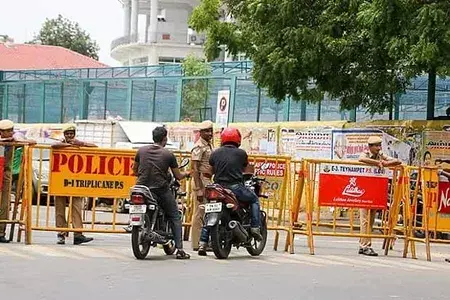

New Delhi: Offices of the Central and Delhi governments will remain closed on September 11 to minimise public inconvenience on roads amid security and logistical arrangements and Motor Carcade movement for the 18th BRICS Leaders' Summit, an official said on Thursday.
The Delhi government had earlier declared a holiday for its offices on September 11. The Ministry of Personnel, Public Grievances and Pensions has now issued an official circular declaring a holiday for Central government offices on the same day.
Ahead of the international event, the Delhi Traffic Police has been conducting rehearsals to manage traffic movement during the Summit.
As part of traffic management drills for events scheduled from September 11 to 13, the Traffic Police has planned diversions at 22 points, with regulated traffic movement on more than 35 roads.
On Wednesday, the Traffic Police enforced curbs and diversions between 10 a.m. and 3 p.m. for a Motor Carcade rehearsal ahead of the BRICS Business Forum and the 18th BRICS Leaders' Summit.
September 12 and 13, being a Saturday and Sunday, are expected to be relatively less challenging for traffic managers handling Summit-related arrangements.

Meanwhile, as part of a technology-driven approach to traffic management, the Delhi Traffic Police is using drones to obtain real-time aerial views of traffic movement across critical stretches of the national capital, Additional Commissioner of Police Vijayanta Goyal Arya said.
Drone surveillance is being carried out over major intersections, arterial roads and congestion-prone corridors to assess real-time traffic conditions, identify emerging bottlenecks and enable timely intervention, Arya added.
The aerial assessment allows traffic teams to monitor congestion build-up and take prompt measures to ensure smoother vehicular movement.
"Particular attention is also being given to inter-state border points and other locations witnessing pile-up of vehicles. Drone-based inputs help assess the length and spread of queues, identify choke points and support better on-ground regulation and dispersal strategies," Arya said.
Aerial monitoring is also being conducted around major transit hubs, including Inter-State Bus Terminals (ISBTs), New Delhi Railway Station and other important railway stations, where heavy vehicular and passenger movement is frequently witnessed.
The real-time inputs help streamline traffic movement and improve coordination at these high-footfall locations.
"In addition, drones are also being deployed ahead of and during large gatherings and processions to assess traffic volume, anticipate congestion and facilitate advance planning of diversions, deployment and other traffic regulation measures," the Additional Commissioner of Police added.

With IANS inputs