















APCR seeks accountability over mosque demolitions
text_fields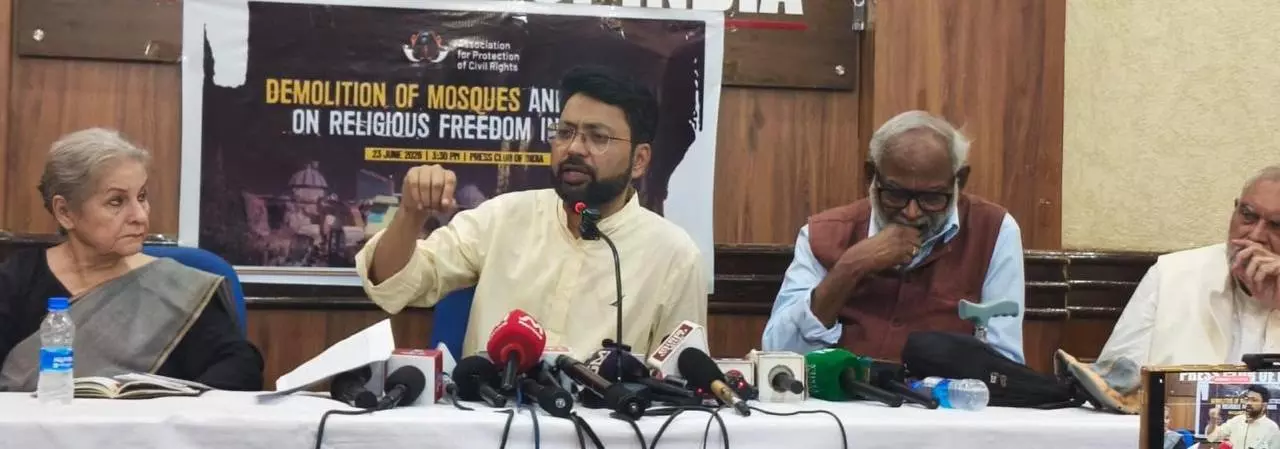
Photo: Maktoob Media

The Association for Protection of Civil Rights (APCR) has expressed concern over what it described as a rising number of mosque demolitions across India, calling for the protection of constitutional guarantees, religious freedom, and legal action against officials involved in unlawful demolitions.
At a press conference held at the Press Club of India in New Delhi under the title “Demolition of Mosques and Attack on Religious Freedom in India,” lawyers, former lawmakers, activists, academics, civil society members, and representatives of affected communities alleged that Muslim places of worship were increasingly being targeted through demolition drives, Maktoob Media reported.
The event was attended by senior advocate and former Union minister Salman Khurshid, former MP Mohammad Adeeb, Jamaat-e-Islami Hind president Malik Mohtasim Khan, former Delhi Minorities Commission chairperson Zafrul Islam Khan, writer and activist Dr Syeda Hameed, human rights defender John Dayal, APCR national secretary Nadeem Khan, and advocates Syed Sadat Ali and Riyasat Ali.
Khurshid described the matter as a prolonged legal struggle and encouraged affected communities to make use of all available legal options.
Adeeb called for legal proceedings against police and administrative officials who were allegedly responsible for illegal demolitions, including financial accountability. He also urged secular political parties to pay greater attention to public concerns, warning that ignoring such issues could have political repercussions.
Malik Mohtasim Khan expressed support for communities affected by demolitions and said that efforts should be made collectively to strengthen those facing oppression.
Zafrul Islam Khan advised communities to continue pursuing judicial remedies regardless of immediate outcomes, arguing that legal action would help establish an official record of events.
Presenting APCR’s findings, Nadeem Khan claimed that at least 20 mosques had been targeted within a 15-day period in Uttarakhand, Uttar Pradesh, and Rajasthan. He alleged that such actions reflected a wider pattern and compared them to previous incidents of mob violence, saying the demolitions had a psychological impact on the Muslim community.
Advocate Syed Sadat Ali, representing affected residents in Rajasthan, claimed that around 300 mosques in Barmer district had received demolition notices. He questioned why religious structures belonging to one community were being singled out when other religious sites also existed in the region.
Representatives from Barmer, Jaipur, Varanasi, Meerut, Sambhal, and Ghaziabad shared accounts of alleged demolitions in their areas. One case discussed was the Noorani Mosque in Nandpuri, Jaipur, a three-storey mosque built in 1981. Speakers claimed that the mosque had been included in a government survey conducted in 2003 and was listed on the Waqf portal, but was demolished without prior notice to its management committee.
Community representatives highlighted the social, cultural, and religious consequences of such demolitions and raised concerns about the absence of consultation, transparency, and adequate legal safeguards.
Participants stressed that the Constitution protects freedom of conscience and the right to practise and propagate religion. They argued that safeguarding places of worship belonging to all communities was necessary to preserve India’s pluralistic character.
The gathering called for stronger accountability, respect for the rule of law, and accessible legal remedies in cases involving religious structures. It urged authorities to ensure that administrative actions are carried out fairly, transparently, and without discrimination while upholding constitutional rights and religious freedom.