



Adhikari calls Muslims arrested over students’ protest ‘notorious criminals’ amid communal profiling allegations
text_fields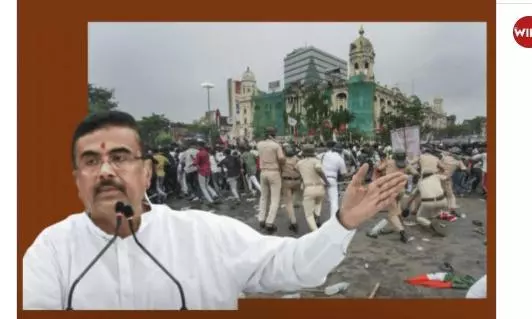

West Bengal Chief Minister Suvendu Adhikari's remarks, "Those Friday People," apparently describe Muslims while invoking the Goonda Act against students arrested in connection with protests held in solidarity with the protesting students at Jantar Mantar, among whom 13 of the 14 arrested were Muslims, thereby tacitly pointing to the Muslim identity of the protesters and further attesting that he is violating the oath he took under the Indian Constitution.
The protest, organised on 24 July by eight Left-affiliated student organisations and joined by several other groups, demanded accountability for the alleged irregularities in the National Eligibility cum Entrance Test (NEET), the abolition of the National Testing Agency (NTA), and the resignation of former Union Education Minister Dharmendra Pradhan.
Following clashes during the demonstration, the police registered seven criminal cases and identified around 70 individuals in connection with the alleged violence. Authorities also invoked the recently enacted West Bengal Public Safety and Control of Anti-Social Activities Act, popularly known as the anti-Goonda law, according to Maktoob Media.
Addressing the State Assembly, Adhikari alleged that opposition parties had mobilised people from predominantly Muslim neighbourhoods, including Kidderpore, Rajabazar, Watgunge, Metiabruz and Park Circus, describing the identified individuals as “mostly notorious criminals”.
He further alleged that “Islamic fundamentalists, possibly with the backing of foreign forces”, were behind the violence. Earlier, while naming several accused, he referred to them as “those Friday people”, a phrase interpreted as linking the alleged offences to the Muslim community.
The arrests have triggered concern among civil rights advocates and legal experts, who argue that the anti-Goonda legislation grants sweeping powers of preventive detention, externment and search, while its broad definition of a “goonda” leaves room for arbitrary application.
A Public Interest Litigation challenging the constitutional validity of the Act is already before the Calcutta High Court, with petitioners contending that the law threatens fundamental rights guaranteed by the Constitution.
Among those arrested is SK Md Salman Hossain, whom supporters describe as a social worker rather than a political activist. His family maintains that no evidence exists showing his involvement in violence, insisting that videos instead depict him cleaning debris from the protest site. Several activists have similarly alleged that Muslim participants are being disproportionately targeted despite constituting only a small fraction of those present at the demonstration.
As the accused were paraded barefoot during a police crime-scene reconstruction ahead of their court appearance, rights groups condemned the action and renewed demands for an impartial investigation into both the violence and the subsequent arrests. They argue that the controversy now extends beyond a student protest, raising broader questions about civil liberties, equal treatment before the law, and the protection of democratic dissent in West Bengal.