












18 calls before Sharif’s murder outside Rampur station raise suspicions of police complicity
text_fields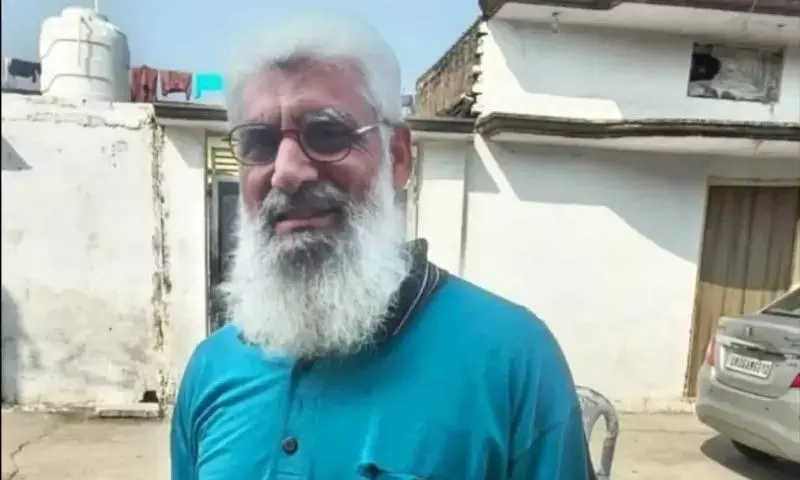

Amid allegations of high-handed police complicity in the daylight murder of Mohammad Sharif Khan outside a Rampur police station, it has emerged that he only attended following a barrage of calls to his relatives, and similar summonses were subsequently issued to his brother-in-law, another individual previously accused and acquitted in the 2007 CRPF camp attack case.
Sharif, a 53-year-old resident of Khajuriya village who had only recently been exonerated by the Allahabad High Court after eighteen years of incarceration, possessed no mobile telephone of his own, and thus the Rampur police officials made 18 calls to his brother, Shahin, and his sister-in-law, the day he was shot dead.
Similar calls were also made to his brother-in-law, Gulab Khan, another accused in the 2007 CRPF camp attack case who was subsequently acquitted, days after Sharif’s murder.
According to call records shared by Sharif’s family with The Wire, the Rampur Police made multiple calls to his relatives, pressing them to ensure his appearance at the police station. Eleven calls were made by a constable identified as Bunty to Sharif’s brother, Shahin Khan, while another seven were directed to his sister-in-law. A senior police officer was also reportedly sent to their residence at around 4 pm.
The repeated calls eventually compelled Sharif to visit the Khajuriya police station. His family said that he was accompanied by his son, Abu Baeez, who later became an eyewitness to the shooting. They were allegedly made to wait for around one-and-a-half hours, although neither the constable who had contacted the family nor the station house officer was present.
As father and son departed on their motorcycle at quarter to five, two masked gunmen intercepted them a mere 500 metres from the station, and they discharged 16 rounds into Sharif’s head, waist, and abdomen while instructing his son to flee into the adjacent fields.
The family contends that the assassination was meticulously orchestrated, for Sharif harboured no personal animosities, and they further allege that local officers deliberately obstructed their path with a patrol vehicle, thereby squandering two crucial hours by insisting the gravely wounded man be transported to a government facility in Bilaspur rather than a private clinic.
Despite Baeez submitting a formal complaint naming both Station House Officer Manoj Kumar Pandey and Constable Bunty alongside the unknown assailants, the resulting First Information Report omits Pandey entirely, and the family has demanded an impartial inquiry by the Central Bureau of Investigation.
His family has alleged that the police delayed his treatment by preventing them from taking him to a private hospital and insisting that he be moved to a government facility in Bilaspur. According to Shahin, more than two hours were lost in deciding where his injured brother should be taken.
The murder has assumed particular significance given that Sharif had been released from Bareilly Central Jail in November 2025, after spending nearly 18 years in prison in connection with the 2007 attack on a CRPF camp in Rampur.
The Allahabad High Court acquitted him and four others on October 29, 2025, observing that serious investigative lapses had undermined the prosecution's case and that the state was at liberty to proceed against the guilty police officers.
Meanwhile, Bareilly Police also contacted Gulab Khan, Sharif's brother-in-law, on November 15, asking him to appear at Baheri police station for verification. Call recordings examined by The Wire reveal that officers questioned him about his movements, family members, relatives and travel arrangements, while repeatedly asking him to inform them before visiting his village.
Khan, who was acquitted in 2019 after spending nearly 11 years in prison, declined to appear, fearing for his safety.
Legal experts have questioned the legitimacy of such verification exercises following acquittal. Lawyer and human rights activist Mohammad Shoaib, who represented the accused in the CRPF case, described the practice as an attempt to harass those who had already been cleared by the court.