















India, EU set to seal long-pending free trade deal on Jan 27
text_fields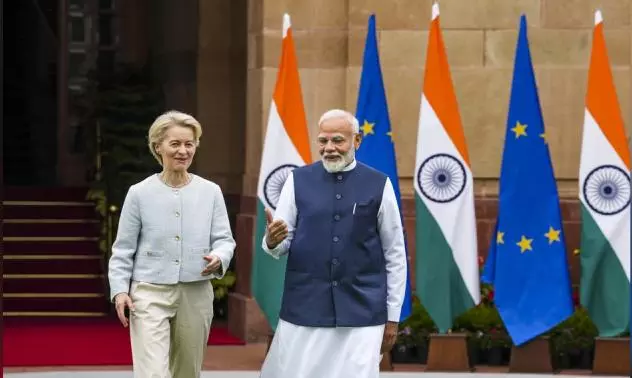

New Delhi: India and the European Union are expected to conclude talks on a long-pending free trade agreement on January 27, a deal leaders on both sides have described as the “mother of all deals.”
Negotiations on the agreement have been ongoing for more than a decade and are seen as a major step in strengthening economic ties between the two regions amid growing global trade uncertainties, reports said.
A research note by Emkay Global dated January 25 indicated that a broad-based free trade agreement could significantly boost India’s trade position with the EU. The deal may increase India’s trade surplus with the bloc by over $50 billion by FY31 and raise the EU’s share in India’s total exports to around 22–23 percent, up from 17.3 percent in FY25, providing a strong push to India’s export growth.
While India currently accounts for only about 0.8 percent of the EU’s export market, the agreement is becoming increasingly important for Europe as well. Europe’s trade balance with India has shifted sharply in recent years, moving from a $3 billion trade surplus in FY19 to a $15 billion trade deficit in FY25.
The deal aligns with Europe’s broader strategy to reduce dependence on China and diversify its global supply chains. Expected gains from the agreement are likely to arise from a gradual shift in the composition of India’s exports to the EU, with higher-value products such as electronics, machinery, and chemicals taking a larger share, moving beyond traditional labour-intensive goods. This is particularly relevant as the EU’s share in India’s exports has slipped to 16.8 percent so far in FY26.
Emkay Global noted that Europe’s reduced reliance on Russian energy and its push to source goods outside China have already increased demand for Indian products, including refined fuels, electronics, and chemicals. A free trade agreement could further strengthen these trends by making trade cheaper and more predictable.
In FY25, total goods trade between India and the EU crossed $136 billion, with India importing $60.7 billion worth of goods and exporting $75.9 billion to the bloc. Experts say trade between the two sides is largely complementary rather than competitive.
Ajay Srivastava, founder of the Global Trade Research Initiative, said Indian exports to the EU—ranging from smartphones, garments, footwear, tyres, pharmaceuticals, auto parts, refined fuels to cut diamonds—mainly replace imports Europe previously sourced from other countries. Many of these manufacturing activities were already offshored by European firms years ago.
EU exports to India include high-end machinery, aircraft, core electronic components, chemicals, advanced medical devices, and metal scrap, supporting Indian factories, recycling units, and MSME clusters, thereby improving productivity and export competitiveness.
The proposed agreement is expected to lower or remove tariffs on India’s labour-intensive products while granting European companies better access to the Indian market for high-end cars and wines. Srivastava added that, as India and the EU specialise in different economic segments, reducing tariffs would mainly cut costs without displacing industries.
With IANS inputs