












Two workers rescued alive from Nepal hydropower tunnel after nine days
text_fields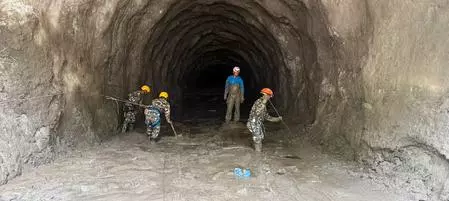
Photo: IANS

Two workers have been rescued alive from a hydropower tunnel in Nepal, nine days after devastating flash floods buried several projects under mud and trapped workers underground.
The rescue operation was carried out at the Trishuli 3A hydropower project, located in one of the areas worst hit by last week’s floods, Nepal Army spokesperson Brig Gen Raja Ram Basnet said, The Guardian reported.
Sanjay Shah was the first worker to be brought out and was taken to the Nepal Army barracks in Trishuli. Another worker, identified as Kabir Maharjan, was subsequently rescued. Basnet said both men were found around 170 metres inside the tunnel.
Shah was working as a foreman at Upper Trishuli 3A, while Maharjan was a supervisor. Images released by the Nepal Army showed Shah being pulled through the narrow, dark tunnel entrance. Covered in mud but conscious, he was carried away from the site on a rescuer’s shoulder.
Officials said both workers were in stable condition and were flown to a hospital in Kathmandu.
While speaking to rescuers, Shah said he had been in the tunnel’s control room when the flood struck. He recalled that although the area normally had only five or six people, there were around 40 to 45 workers inside at the time.
Shah said that as he was responsible for the control room, he felt obliged to help others escape rather than flee on his own. He alerted workers to what he described as a major accident at the dam and urged them to get out, but the time spent helping others ultimately prevented him from escaping himself.
He told rescuers that he kept himself calm during his nine days underground by chanting mantras. While trapped, he said he was able to communicate with only three or four other people, who shouted to one another from nearby sections of the tunnel.
Shah also said there could have been workers inside the powerhouse and expressed uncertainty over whether all of them had managed to escape.
Nepal’s communication minister Bikram Timilsina said authorities remained hopeful that more workers would be found alive and rescued, indicating that the search operations would continue.
Most hydropower projects along the Bhote Koshi and Trishuli rivers were destroyed last week after a massive surge of water, mud and debris swept through the valleys. The floods were triggered by the collapse of a melting glacier along the border between Nepal and China-controlled Tibet.
According to Nepal’s disaster management agency, at least 1,259 people have died in the floods, while more than 5,000 remain missing.
Rescue operations have increasingly focused on hydropower tunnels, where authorities believe workers could have survived for more than a week by sheltering in air pockets. More than 270 people have so far been rescued from several projects.
Floodwaters and large boulders blocked tunnel entrances, while some sections were buried deep under mud. At the Upper Trishuli 3A project, rescue teams took nearly six days to locate the tunnels.
Army personnel and specialist rescue teams have been working around the clock to clear debris from the entrances. Authorities said they heard the voices of several people trapped inside after rescuers made a breakthrough early on Friday.
The Independent Power Producers Association of Nepal said at least 557 workers were missing from hydropower projects along the Trishuli River, with around 115 believed to be trapped inside the main tunnel.
Families of missing workers have spent nine days gathering at hospitals in Kathmandu and at the Nepal Electricity Authority office, seeking information about their relatives. Posters featuring workers missing from Trishuli 3A and other hydropower projects have been displayed on the walls of Tribhuvan University Teaching Hospital in the capital.
Local authorities stated that close to 900 workers are missing from 12 hydropower projects located high in the Himalayas, with approximately 500 believed to be trapped inside tunnels.
Rescue operations are also continuing at the Rasuwagadhi hydropower plant, where authorities believe 46 workers trapped in an underground chamber are still alive.