



















Reports of abuse, cover-ups reveal reality of Palestinians in Israel’s prisons
text_fields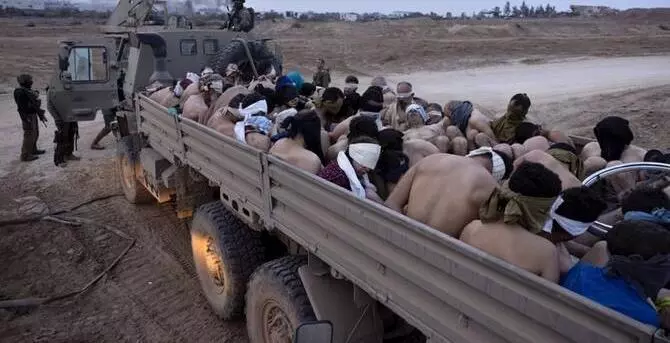
Photo: AP

London: The release of a video showing the alleged abuse of a Palestinian detainee by Israel Defense Forces personnel has sparked controversy, not over the soldiers’ actions but over the decision to make the footage public. Much of the criticism has been directed at the military’s chief legal officer, rather than those involved in the assault.
The surveillance footage, recorded in July 2024 at the Sde Teiman military base in Israel’s Negev desert, was released to local media a month later by Yifat Tomer-Yerushalmi, the IDF’s military advocate-general.
Tomer-Yerushalmi resigned on October 31, explaining that she had authorised the video’s release to counter what she described as misinformation targeting the army’s law enforcement divisions. She said it was the military’s responsibility to investigate whenever credible evidence of violence against detainees emerged.
In her resignation statement, Tomer-Yerushalmi also revealed that military prosecutors handling the case had faced intense personal attacks, verbal abuse, and even threats as they sought to press charges against the soldiers accused in the incident, Arab News reported.
Israel’s defense minister, Israel Katz, expressed approval of Yifat Tomer-Yerushalmi’s resignation, aligning with the government’s position on the matter. He said that anyone who, in his view, spread false accusations against IDF soldiers was unworthy of serving in the military.
The former military advocate-general was taken into custody on Monday, shortly after stepping down from her position.
When the footage was first broadcast on an Israeli television channel in August 2024, commentators compared it to the infamous abuse of Iraqi prisoners by U.S. forces at Abu Ghraib prison in 2004.
At that time, despite widespread international condemnation, most of the 12 American soldiers involved received relatively light punishments, and no one was charged in connection with the death of a detainee or the other deaths reported at the facility.
In the Sde Teiman case, five Israeli soldiers were later charged with abuse and causing bodily harm following the release of the video. However, their identities have not been made public, and none of them has yet gone to trial.
According to the indictment, filed around seven months after the incident, the soldiers allegedly beat the Palestinian detainee, used a taser on him, and stamped on his body while he was lying on the floor, resulting in fractured ribs and a punctured lung.
Reports have alleged that the detainee was subjected to a particularly brutal form of sexual assault with a knife, damaging his rectum.
Despite the gravity of the accusations, several right-wing politicians in Israel reportedly praised the soldiers involved, calling them heroes and staging demonstrations in their defence. They also accused military investigators of betrayal for pursuing the case.
According to local media, four of the accused soldiers appeared before reporters outside Israel’s Supreme Court in Jerusalem on Sunday, their faces concealed by balaclavas. During the press conference, their legal team denounced what they described as a biased and fabricated legal process and demanded that the charges be dismissed.
Observers have suggested that the incident reflects a broader trend of growing influence by far-right elements, who appear willing to undermine the rule of law and adherence to human rights norms in Israel.
Additional reports surfaced the same day, claiming that Yifat Tomer-Yerushalmi, the former military advocate-general, had refrained from investigating certain alleged war crimes in Gaza because she feared backlash from right-wing groups. Sources within her office reportedly indicated that she had faced threats from extremist circles—some directed even at her home—which may have influenced her hesitation to pursue sensitive cases.
Rights groups have noted that the abuse recorded at the Sde Teiman base appears to be part of a wider pattern of mistreatment of Palestinian detainees by Israeli forces.
According to Budour Hassan, a researcher at Amnesty International focusing on Israel and the Occupied Palestinian Territory, data from the Israeli NGO HaMoked shows that as of November 2025, over 9,200 Palestinians were in Israeli custody.
Of these, more than 4,500 were being held without formal charges or trial — including thousands under administrative detention orders or the Unlawful Combatants Law — leaving many imprisoned indefinitely without due process.
Hassan said Israel has long relied on arbitrary detention as a primary tool to maintain an apartheid system against Palestinians. The organisation’s investigations have documented widespread instances of torture and inhumane treatment in Israeli detention centres, ranging from physical and sexual violence to deprivation of food.
Detainees have also reportedly been denied visits from family members and access to independent observers or humanitarian agencies. Many are said to have been forcibly disappeared, leaving families with no information about their relatives’ conditions or whereabouts.
In August 2024, the Israeli human rights organisation B’Tselem released a report titled “Welcome to Hell,” drawing its name from an inmate’s chilling description of the “welcome” he received at Megiddo Prison. The findings were based on testimonies from 55 Palestinians detained after October 7, 2023.
According to B’Tselem, more than a dozen Israeli military and civilian prisons had effectively been converted into what it described as “a network of camps dedicated to the abuse of inmates.” The organisation said that these facilities operated as “de facto torture camps,” where detainees were systematically subjected to severe and ongoing physical and psychological suffering.
Palestinian writer Nasser Abu Srour, who was released in October 2024 under the U.S.-brokered Gaza ceasefire deal after more than 32 years in Israeli custody. He told The Guardian from Egypt, where he had been exiled, that the situation in Israeli prisons had deteriorated sharply since the war began. He said guards began behaving as though they were on a battlefield, resorting to violence, torture, and even killings against prisoners.
After the onset of the Gaza war, the treatment of long term Palestinian prisoners reportedly worsened significantly, with accounts describing increased physical assaults, deprivation of food, and denial of heating.
A Palestinian human rights lawyer who chose to remain anonymous due to their own ongoing trial recounted to Arab News the severe conditions inside Israeli detention centres, saying that communication with the outside world had been completely cut off, giving the Israeli Prison Service broad freedom to isolate and mistreat detainees.
According to the lawyer, guards appeared to exercise unchecked authority to humiliate, torture, and assault prisoners.
Reports of mistreatment have also extended to minors. Miranda Cleland, an advocacy officer with Defense for Children International – Palestine, said her organisation has for years documented abuse of Palestinian children by Israeli forces.
She noted that testimonies from child detainees have consistently described Israeli forces arresting children in the middle of the night from their homes, blindfolding, hand-binding, and coercive interrogations aimed at forcing confessions. Since October 2023, she added, Israeli forces have escalated such practices and worsened prison conditions for minors.
On Sunday, Israeli Prime Minister Benjamin Netanyahu appeared to focus his criticism not on the abuse itself but on the release of the Sde Teiman footage, calling the leak “the most serious public-relations attack” against Israel and saying it had caused “enormous reputational damage” to the country, its army, and its soldiers.