


Despite knowledge of being potential targets, journos continue telling Gaza's story
text_fields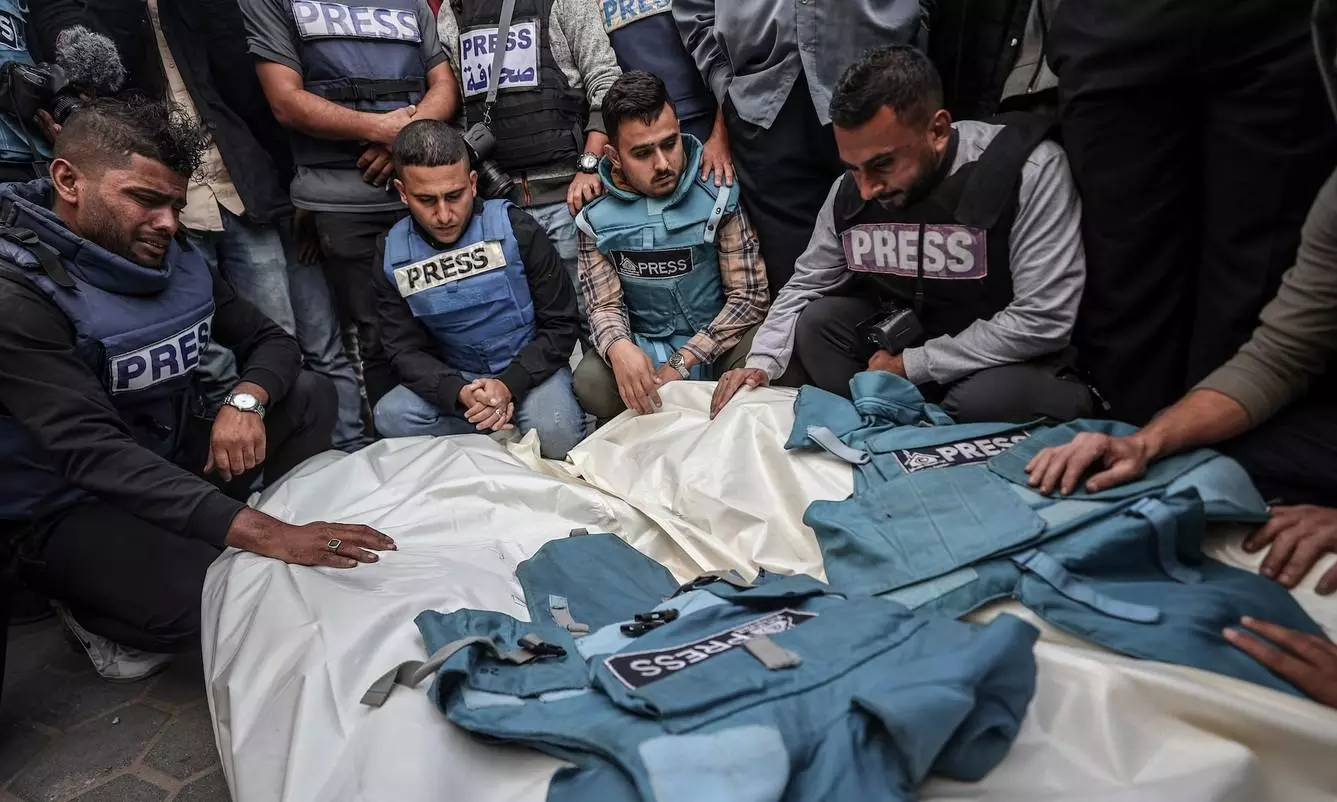
Anadolu Agency photo.

Beirut: Journalists in Gaza are working in dire conditions to tell Gaza’s story, completely aware that they are making themselves an Israeli target, the Associated Press reports.
So far, around 200 news workers have been killed by Israeli forces while working to bring Gaza's story to the world, and the latest among them was the death of five journalists on August 25 when Israel struck Nasser Hospital. Those killed in the attack, which left a total of 22 people dead, included Mariam Dagga, 33, a visual journalist who freelanced for The Associated Press and other outlets.
Like the vast majority of Gaza's population, most of its journalists have seen their homes destroyed or damaged during the war and have been repeatedly displaced after evacuation orders by Israel's military. Many have mourned the deaths of family members.
But journalists and advocates say the trials go well beyond. Every workday, they say, is shadowed by an awareness that covering the news in Gaza makes them singularly visible in the conflict, putting them at extraordinary risk.
For journalists in Gaza, “it's about dying or living, escaping violence or not. It's something we cannot compare (to other wartime journalism) at any level,” said Mohamed Salama, a former reporter in Egypt who is now an academic, researching the life of news workers in the Strip.
Israel calls the strikes a 'tragic mishap' but also levels accusations. After the August strikes, Israeli Prime Minister Benjamin Netanyahu insisted that the military was not deliberately targeting journalists and called the killings a “tragic mishap.” After a preliminary review, the military said the attack had targeted what it believed to be a Hamas surveillance camera and that six of the people killed were militants, but offered no evidence.
Late last month, the AP and Reuters — which lost a cameraman and a freelancer in the attack on the hospital — demanded that Israel provide a full account of what happened and “take every step to protect those who continue to cover this conflict.” The news organisations issued their statement on the one-month anniversary of the strikes.
Israeli officials have previously accused some journalists in Gaza of being current or former militants. They include Anas al-Sharif, a well-known correspondent for Al Jazeera who was killed in an early August strike on a media tent outside another Gaza hospital. Four other journalists were also killed in the attack.
The Israeli military, citing documents it purportedly found in Gaza, as well as other intelligence, had long claimed that al-Sharif was a member of Hamas. He was killed after what press advocates said was an Israeli “smear campaign” stepped up when al-Sharif cried on air over starvation in the territory.
There is a long, sometimes tragic history of journalists risking personal safety to cover conflicts. But the risks, trials and toll of doing so have never been higher than they are in Gaza right now, experts say.
Since the war was ignited by the Hamas attack on Israel nearly two years ago, 195 Palestinian media workers have been killed by Israeli forces in Gaza, according to the Committee to Protect Journalists.
Journalist deaths in Gaza have now surpassed the combined number killed during the US Civil War, World Wars I and II, the Vietnam and Korean wars, the war in Yugoslavia that ended in 2001 and the Afghanistan War, the project said in a report issued earlier this year.
In a separate survey of Gaza news workers last year by Arab Reporters for Investigative Journalism, nine in 10 said their homes had been destroyed in the war. About one in five said they had been injured, and about the same number had lost family members. That was before Israel resumed fighting in March after a brief ceasefire.