


















It's Nuclear Clocks! Is it the future of timekeeping?
text_fields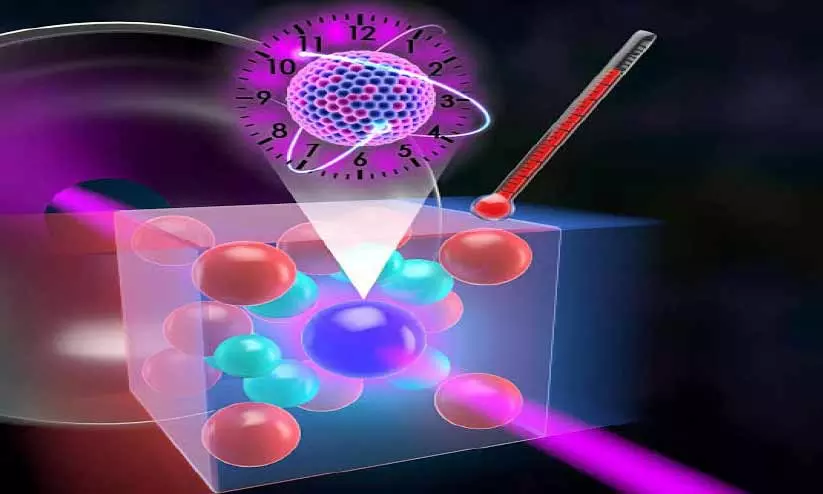
Representational.

Scientists in Austria and China have independently developed nuclear clocks, a breakthrough that could eventually surpass atomic clocks in precision and open new avenues for exploring the fundamental laws of the universe.
Researchers at the Vienna University of Technology in Austria and Tsinghua University in Beijing, alongside scientists from other institutions, developed separate nuclear clock systems. Their findings were published in two independent papers in the journal Nature on October 7.
Atomic clocks, currently the gold standard for timekeeping, measure time using frequencies associated with electrons transitioning between different energy levels within atoms. Nuclear clocks instead rely on changes in the energy levels of an atom’s nucleus.
Because atomic nuclei are extremely small and relatively less susceptible to external disturbances, scientists believe nuclear clocks could eventually achieve unprecedented accuracy. Both developments rely on thorium-229, an isotope of the radioactive element thorium.
Although the new devices are operational, they have not yet outperformed the most precise existing optical atomic clocks. Researchers expect further technological advances to overcome this limitation and unlock the technology’s full potential.
Beyond precision timekeeping, nuclear clocks could help scientists investigate elusive phenomena, including dark matter, which is believed to account for a substantial portion of the universe’s matter.
Researchers in Vienna used their nuclear clock to investigate whether dark matter could cause minute changes in the energy levels of thorium-229 nuclei. Although the experiments did not detect dark matter, they demonstrated the technology’s potential for probing subtle physical effects.
The development marks a significant step towards next-generation timekeeping and could help scientists test fundamental physical theories with greater precision.